
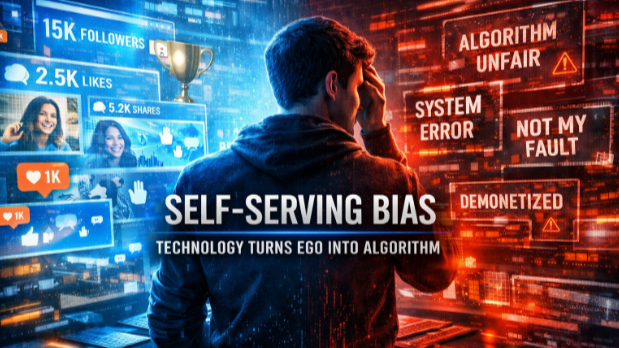
In the digital age, we curate our lives through screens — every success amplified, every failure explained away. Beneath this pattern lies a psychological phenomenon first identified long before social media existed:
Self‑serving bias, the tendency to attribute success to ourselves and blame failure on external forces.
The Origins of Self‑Serving Bias
The term self‑serving bias was formally coined by psychologists Dale T. Miller and Michael Ross in their 1975 paper “Self‑Serving Biases in the Attribution of Causality: Fact or Fiction?”
Their research built on earlier attribution theory, which explored how people explain causes of behavior and outcomes.
Miller and Ross’s Key Ideas – Internal success, external failure:
People credit ability and effort for achievements but blame luck or unfairness for setbacks.
Cognitive roots: The bias isn’t just emotional — it stems from how we process expectations and causal relationships.
Universal pattern: It appears across cultures, ages, and contexts, from classrooms to boardrooms.
Protective function: It helps maintain self‑esteem and psychological stability, though at the cost of objectivity.
Their work became foundational in social psychology, influencing studies on motivation, leadership, and group dynamics.
Technology’s Amplification Effect
Social media platforms have transformed this quiet mental reflex into a public performance. Algorithms reward confidence, success, and emotional engagement — the perfect conditions for self‑serving bias to thrive.
1. Algorithmic Validation
Likes, shares, and follower counts act as digital trophies. Success feels personal; failure feels algorithmic. The design reinforces the instinct to claim credit and deflect blame.
2. Emotional Engagement Loops
Platforms prioritize content that triggers pride or outrage — both ego‑protective emotions. Posts celebrating wins or blaming external forces for losses spread faster, creating a feedback loop of self‑affirmation.
3. Comparison Culture
Constant exposure to curated success stories heightens the need to protect self‑image. Users internalize victories and externalize setbacks, mirroring the bias Miller and Ross described decades ago.
4. Collective Attribution
Online communities often normalize external blame — “the system is rigged,” “the algorithm is unfair.” These narratives turn individual bias into group identity.
Closing
Self‑serving bias began as a psychological curiosity; today, it’s a cultural force shaped by technology. The same instinct that once helped us preserve self‑esteem now drives how we present ourselves online. In a world of metrics and mirrors, understanding this bias isn’t just academic — it’s essential for reclaiming authenticity in the age of algorithms.