
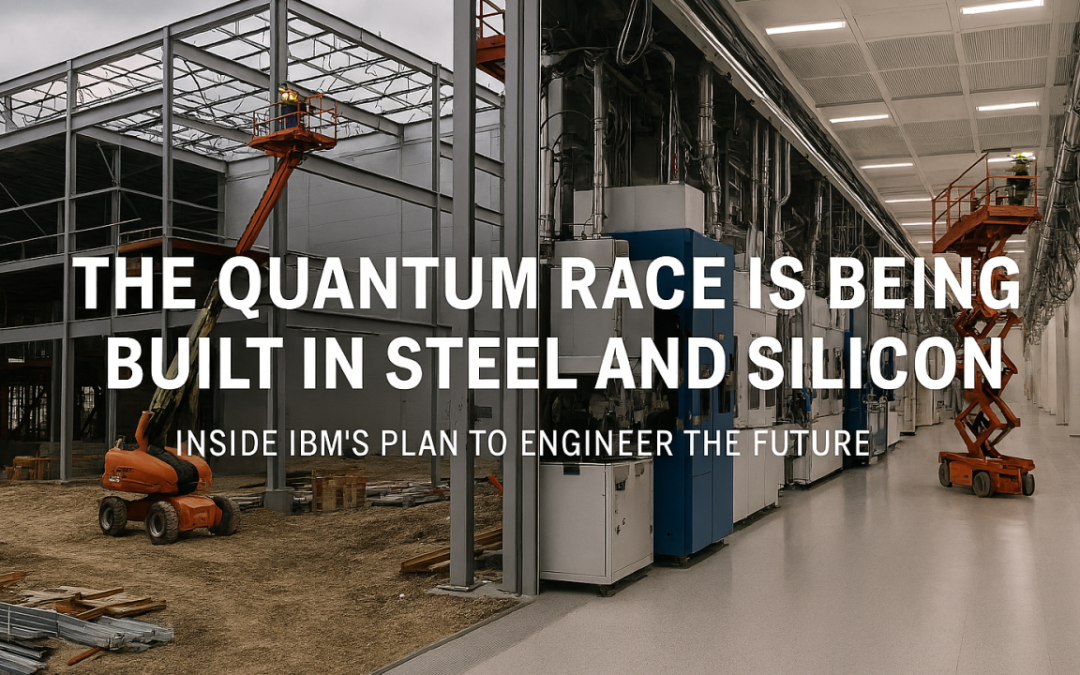
Some factories produce steel, others silicon—but a new class of facility is emerging that manufactures something far more profound: the very building blocks of reality as computation. Deep within ultra-clean fabrication halls and cryogenic test chambers, IBM is constructing the infrastructure not just for faster computers, but for a fundamentally different way of processing information. These quantum foundries represent a turning point where physics leaves the blackboard and becomes engineered at scale—where the strange, probabilistic nature of the quantum world is no longer merely observed, but harnessed.
I. The Rise of Quantum Fabrication Facilities
IBM’s decision to fabricate all future quantum processors using 300 mm semiconductor wafer technology at the NY Creates Albany NanoTech Complex represents a fundamental transition from laboratory-scale prototyping toward industrial-scale quantum manufacturing. This facility, among the most advanced semiconductor fabrication environments in the world, enables quantum processors to be manufactured with precision comparable to classical silicon chips—an essential step toward scalability. [ny-creates.org], [ibm.com]
The move to 300 mm wafers is not a cosmetic upgrade. It results in:
- 2× faster research and development cycles
- Up to 10× increase in chip physical complexity
- Parallel fabrication of multiple processor designs [quantumcom…report.com], [convergedigest.com]
This industrialization of quantum fabrication is complemented by broader ecosystem expansion. For instance, IBM’s participation in new quantum-focused technology hubs (such as large-scale quantum parks and innovation centers) demonstrates the geographic and institutional scaling required to support quantum infrastructure and workforce development. [nprillinois.org]
Crucially, fabrication is no longer isolated from theory. Physicists, materials scientists, and semiconductor engineers work in tight synchrony across sites such as Albany and IBM’s Watson Research Center, reflecting the interdisciplinary nature of quantum hardware design. [ny-creates.org]
A consequential extension of this vision is unfolding in the American Midwest, where IBM has committed to a major presence within Chicago’s emerging quantum ecosystem. As part of the Illinois Quantum and Microelectronics Park, IBM’s planned FutureNow innovation and delivery hub represents a strategic expansion beyond fabrication and into system integration, workforce development, and applied quantum computing. Backed by significant public investment and slated for phased completion beginning in 2027, this campus is designed to anchor a regional cluster of quantum research, advanced computing, and industrial collaboration. While not yet a primary fabrication site, the Chicago initiative reflects a critical evolution in IBM’s approach: the recognition that scaling quantum computing is not solely a matter of building better chips, but of cultivating an entire ecosystem capable of deploying, maintaining, and innovating upon them. In this sense, the Midwest becomes not just a geographic expansion, but a necessary layer in the architecture of quantum scalability—bridging the gap between experimental hardware and real-world application.
II. Capabilities of IBM’s Modern Quantum Chips
At the heart of these fabrication advances lie processors such as IBM Quantum Nighthawk, a 120‑qubit superconducting device designed explicitly for near-term quantum advantage. Its architecture incorporates: [quantumcom…report.com], [prnewswire.com]
- 120 superconducting qubits
- 218 tunable couplers enabling dense connectivity
- Support for ~5,000 two-qubit gate operations
- ~30 % increase in computational circuit complexity relative to prior designs [quantumcom…report.com], [prnewswire.com]
These figures are not merely engineering metrics; they translate directly into the ability to execute deeper quantum circuits, which are essential for simulating chemistry, optimizing materials, and solving constrained combinatorial problems.
IBM’s roadmap shows an aggressive scaling trajectory:
- 2026: Verified quantum advantage (outperforming classical methods for certain tasks)
- 2027–2028: Systems reaching 7,500–15,000 gate operations
- 2029: Fault-tolerant system (“Starling”) with ~200 logical qubits executing 100 million gates [openaimpact.com], [postquantum.com]
This transition—from noisy intermediate-scale devices to error-corrected logical qubits—marks the difference between experimental apparatus and truly useful computation.
III. The Physical Substrate: Superconducting Qubits
IBM’s processors rely on superconducting qubits, engineered circuits that behave as artificial atoms. These systems exploit two phenomena:
- Superconductivity (zero electrical resistance at cryogenic temperatures)
- Josephson junction nonlinearity, which discretizes energy states into usable quantum levels [en.wikipedia.org], [postquantum.com]
A qubit is realized as the lowest two energy states of such a circuit. Unlike classical bits, which occupy definite states (0 or 1), qubits exist in superposition, allowing them to represent multiple computational paths simultaneously. [nist.gov]
Furthermore, qubits interact via entanglement, a non-classical correlation enabling exponential scaling of computational state space. However, these advantages come at a cost: qubits are fragile. Environmental disturbances induce decoherence, collapsing quantum states and introducing computational errors. [www6.slac….anford.edu]
Thus, the central engineering challenge of IBM’s fabrication program is not merely scaling qubit count, but preserving coherence while enabling dense connectivity and high-fidelity operations.
IV. From Quantum Mechanics to Quantum Fields
To fully appreciate the significance of quantum computing, one must step beyond the qubit and into the deeper framework of quantum field theory (QFT).
Where standard quantum mechanics treats particles as discrete objects, QFT reinterprets them as excitations of underlying fields that permeate spacetime. In this view: [mindfulchase.com]
- The electron is an excitation of the electron field
- The photon is an excitation of the electromagnetic field
- The vacuum itself is a dynamic entity, not emptiness
This ontological shift is profound. It implies that what we call “particles” are localized vibrational modes of continuous fields.
Mathematically, QFT extends quantum mechanics by promoting field amplitudes to operators obeying commutation relations. Interactions are described through Lagrangians and computed via techniques such as:
- Feynman diagrams
- Renormalization procedures
- Operator-valued distributions [mindfulchase.com]
V. The Convergence: Quantum Computing Meets Field Theory
Quantum computing is not merely inspired by quantum mechanics—it is increasingly a tool for exploring quantum field theory itself.
Quantum computers can simulate field theories by discretizing spacetime into lattices and mapping field variables onto qubit registers. This allows:
- Simulation of particle interactions
- Computation of ground-state energies
- Exploration of non-perturbative regimes inaccessible to classical methods [emergentmind.com]
This capability is transformative. Classical simulation of QFT suffers from exponential complexity; quantum systems, by their very nature, evolve within quantum state spaces and can therefore model such systems efficiently.
In a deeper sense, the hardware of a quantum computer is itself an engineered quantum field system. Superconducting circuits are macroscopic manifestations of quantum fields, where collective electron behavior forms coherent quantum states.
Thus, quantum computers represent a recursive idea:
Physical systems governed by quantum fields are used to simulate other quantum fields.
VI. Philosophical and Engineering Implications
The alignment of fabrication technology with quantum field theory represents a convergence rarely seen in engineering:
- Industrial scale meets fundamental physics
- Cryogenic hardware embodies abstract Hilbert spaces
- Silicon manufacturing becomes a medium for manipulating the vacuum structure of fields
IBM’s fabrication plants therefore should not be seen as mere chip factories. They are controlled environments designed to engineer quantum reality itself, where the boundary between physics experiment and computational device dissolves.
VII. Closing Reflection
What IBM is building is not simply a new generation of processors—it is constructing the physical foundation for a new way of thinking, computing, and ultimately discovering. The fabrication plants in New York, the emerging ecosystem in Chicago, and the roadmap toward fault-tolerant machines are all pieces of a much larger transformation: the transition from observing quantum mechanics to actively deploying it at scale. [ny-creates.org], [nprillinois.org]
The real question is no longer if quantum computing will matter, but how quickly it will begin reshaping the boundaries of what is solvable. When machines can reliably execute millions—even hundreds of millions—of quantum operations, problems that once defined the limits of science may become tractable engineering tasks. Chemistry, cryptography, climate modeling, and even the simulation of the universe’s most fundamental fields will shift from approximation toward precision. [postquantum.com]
But perhaps the most compelling reason to pay attention is this: for the first time, humanity is building tools that operate on the same principles as the universe itself. These quantum systems are not abstractions—they are controlled expressions of the underlying fields and interactions that constitute reality. As such, they blur the line between experiment and machine, between physics and technology.
And that is what makes this moment so engaging.
We are no longer just designing computers.
We are learning how to engineer reality—and then ask it questions we have never been able to ask before.