
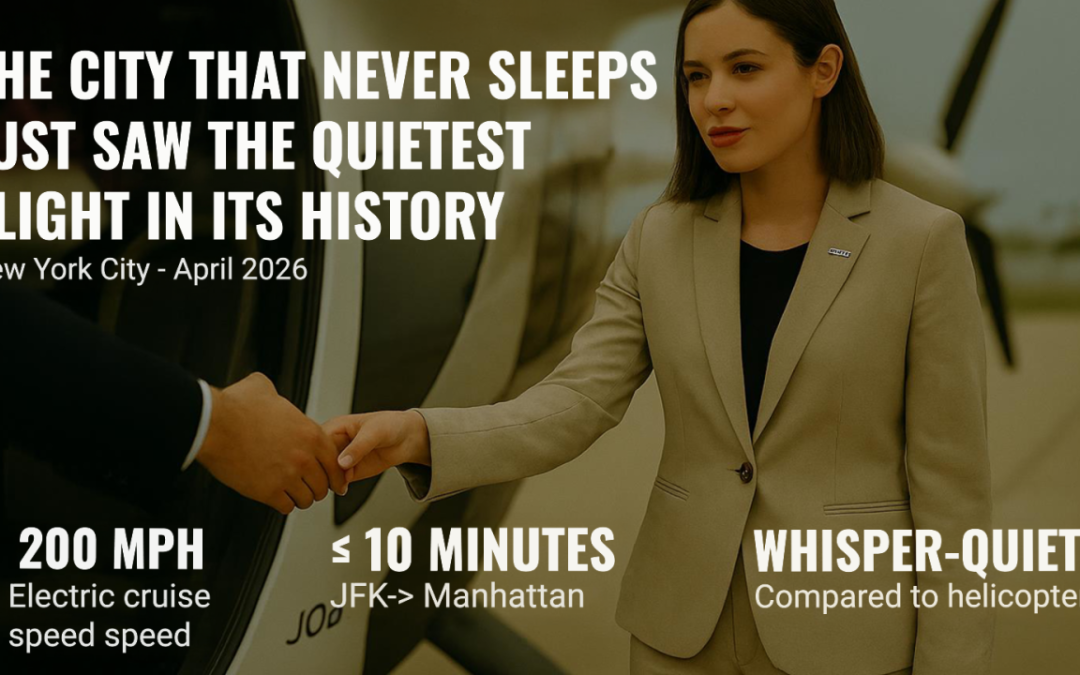
There was no ribbon‑cutting, no flyover spectacle, no roar echoing off the Hudson.
When Joby Aviation’s electric air taxi lifted off from JFK and headed toward Manhattan this spring, what stood out most was how unremarkable it felt. To New York’s skyline. To nearby neighborhoods. To the airspace itself.

For engineers, that absence of drama meant something profound: the system worked.
These were the first point‑to‑point electric air taxi flights in New York City history, conducted in live FAA‑controlled airspace, using existing heliports, alongside conventional aviation traffic. Not a demo circuit—an operational route.
New York is not a sandbox. If advanced air mobility could close the engineering loop here, it could close it anywhere.

Why New York Matters to Engineers
Urban air mobility hasn’t been waiting on imagination. It’s been waiting on convergence:
- Propulsion capable of repeated duty cycles
- Acoustic profiles acceptable to dense cities
- Redundancy architectures acceptable to regulators
- Infrastructure compatibility with legacy assets
- Certification pathways that don’t rely on exceptions
New York compresses all of these constraints into one environment.
Joby chose to engage with that complexity early. And that choice defines why this milestone stands apart.

The Aircraft Behind the Moment: Joby, Quantified
Joby’s production‑intent aircraft reflects a conservative, infrastructure‑aware engineering philosophy:
Joby eVTOL – Key Technical Characteristics
- Configuration: Piloted tilt‑rotor eVTOL with distributed electric propulsion
- Capacity: 4 passengers + pilot
- Cruise speed: ~200 mph (≈320 km/h)
- Design range: Up to ~150 miles (≈240 km)
- Maximum takeoff weight: ~2,177 kg
- Service ceiling: ~11,000 ft
Six tilting electric propulsors handle both vertical lift and forward cruise—reducing hover time and improving energy efficiency over longer routes. The aircraft is optimized not just for downtown hops, but for networked urban‑regional missions.
From an engineering standpoint, range isn’t about distance—it’s about margin.
Distributed Electric Propulsion and Redundancy
Joby’s use of distributed electric propulsion (DEP) enables:
- Multiple independent thrust paths
- Continued safe flight after motor or power‑electronics failures
- Lower disk loading and improved hover efficiency
- Strong control authority during transition
Rather than duplicating entire systems, redundancy is embedded into architecture—aligning closely with traditional aerospace safety principles instead of experimental exemptions.

Acoustic Engineering: Designing for Acceptance, Not Silence
Noise—not speed—is the gating constraint for cities.
Joby’s aircraft is designed to avoid the impulsive, high‑contrast noise signatures that make helicopters objectionable. Instead, its tonal profile blends into ambient city sound—a psychoacoustic approach engineers will recognize as more effective than raw decibel reduction.
In a city like New York, success is measured by what residents don’t notice.
Certification Is a Performance Metric
These flights were conducted under the FAA’s eVTOL Integration Pilot Program, using aircraft aligned with certification requirements—not one‑off configurations.
Flight hours logged in real airspace, interacting with live operations, matter far more than controlled test ranges. Certification maturity is part of the product.
Infrastructure: The Unseen Engineering Win
Joby deliberately used existing heliports—Downtown Skyport, East 34th Street, West 30th Street, and JFK.
That choice imposed real constraints:
- Structural load limits
- Clearance envelopes
- Electrical interface requirements
- Thermal considerations
Instead of demanding new infrastructure, Joby engineered compatibility with what already exists—a hallmark of deployable systems.
Context, Not Competition: Where Archer Fits In
Joby’s milestone doesn’t erase competitors. It contextualizes them.
Archer Aviation’s Midnight remains a credible, well‑engineered aircraft optimized for short‑range, high‑frequency urban routes.
Archer Midnight – Key Technical Characteristics
- Configuration: Lift‑plus‑cruise eVTOL
- Capacity: 4 passengers + pilot
- Cruise speed: ~150 mph (≈240 km/h)
- Target range: ~100 miles (≈160 km)
- Propulsion: 12 electric propellers 6 fixed vertical‑lift 6 tilting for cruise
- Battery system: 6 independent battery packs
Midnight’s segmented propulsion and battery architecture prioritizes hover stability, thermal recovery, and rapid turnaround—engineering choices that support repetitive missions.
Archer has been explicit about sequencing: launching first in lower‑complexity cities, gathering operational data, then expanding into markets like New York. That’s not hesitation—it’s risk management.
Systems Engineering—Side‑by‑Side (Simplified)
Joby: Integrated Tilt‑Rotor System
- One propulsion system handles hover and cruise
- Shared high‑energy battery architecture
- Fewer vertical‑only components
- Optimized for cruise efficiency and range
- Redundancy via distributed thrust
Archer: Lift‑Plus‑Cruise Modular System
- Separate lift and cruise propulsion
- Multiple independent battery packs
- High hover stability
- Vertical‑only mass in cruise
- Redundancy via architectural segmentation
Engineering takeaway: Joby optimizes for integration and complexity tolerance. Archer optimizes for throughput and certification sequencing.
Both are valid. Only one has now closed the loop in New York.
Why Joby’s Milestone Stands
Joby was first to demonstrate:
- Integration with the most complex urban airspace in the U.S.
- Use of legacy infrastructure without special treatment
- Acoustic acceptability in a dense city
- System maturity beyond controlled trials
This wasn’t just a flight. It was system‑level validation under maximum constraint.
Final Thought
Electric air taxis won’t change cities because they’re exciting.
They’ll change cities when they behave like infrastructure: predictable, quiet, safe, and almost invisible.
New York barely noticed Joby’s flight.
For engineers, that’s the loudest signal of progress yet.
