
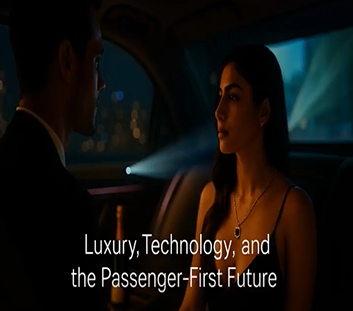
For more than a century, luxury automobiles were built around the driver. Horsepower, steering feel, and mechanical refinement defined prestige. But as assisted driving evolves toward genuine autonomy, the definition of luxury is shifting dramatically. In the world’s most forward‑looking luxury cars, the passenger—particularly the rear passenger—has become the primary customer. This shift is evident in the rapid expansion of in‑cabin technology, screen real estate, privacy systems, and lounge‑like rear compartments designed not just for comfort, but for productivity, security, and entertainment. [carinterio…libaba.com], [linkedin.com]
Preparing for a Self-Driving Future
While true Level 4 or Level 5 autonomy is still emerging, luxury brands are already designing interiors as if the driver will soon become optional. Level 2 and Level 3 systems—such as Mercedes‑Benz’s Drive Pilot and BMW’s advanced assisted driving suites—have freed occupants to disengage from the road for extended periods, accelerating the demand for “time‑well‑spent” cabin experiences. [autopilotreview.com], [youtube.com]
This anticipation has sparked three major design trends:
- Expanded surface area for digital displays
- Enhanced privacy and acoustic isolation
- Rear-seat environments that resemble private lounges or mobile theaters
Nowhere are these ideas more aggressively executed than in the new wave of tech‑led Chinese ultra‑luxury vehicles.
The Maextro S800: A Passenger Lounge on Wheels
The Huawei‑backed Maextro S800—often described as “the Rolls‑Royce of China”—represents one of the most extreme examples of passenger-focused luxury currently in production. Built in partnership with JAC Group, the S800 was conceived from the ground up as a chauffeur‑oriented, autonomy‑ready flagship rather than a driver’s sedan. [insidechinaauto.com], [en.wikipedia.org]
What sets the S800 apart is its treatment of the rear cabin:
- A 40‑inch rear projection cinema screen that deploys electrically, creating a fully isolated theater environment [autoblog.com], [supercarblondie.com]
- Touch‑variable smart glass windows that can instantly transition from transparent to opaque for total privacy
- Motorized blinds, acoustic damping, and active noise cancellation that seal the rear compartment from the outside world
- A fingerprint‑secured safe, refrigerator, fold‑out tables, and executive rail‑mounted seating designed for long-duration occupancy [youtube.com], [en.wikipedia.org]
These features signal a philosophical shift: the S800 is not primarily about driving pleasure—it is about what happens after the driving is automated.
Screen Real Estate as the New Luxury Metric
Across the luxury market, screen size has become a visible status symbol. BMW’s i7 introduced a 31‑inch 8K “Theater Screen” that folds down from the ceiling, turning the rear cabin into a cinema controlled by door‑mounted touch panels. Mercedes‑Maybach counters with dual rear displays integrated into its MBUX ecosystem, paired with 4D spatial audio and fully reclining executive seats. [timesnownews.com] [carinterio…libaba.com]
What distinguishes the Maextro S800 is its use of projection rather than direct-display panels, allowing a much larger visual field without permanently occupying cabin space—an approach more akin to private aviation than traditional automobiles. [autoblog.com]
Privacy as a Core Luxury Feature
As vehicles become increasingly connected, privacy is emerging as a premium differentiator. Rolls‑Royce formalized this trend with its Phantom Privacy Suite, featuring electrochromatic glass partitions and complete acoustic isolation between driver and rear passengers. [press.roll…orcars.com]
The S800 expands on this concept with full digital control over visibility, data access, and physical security. Biometric authentication, secure storage, and isolated infotainment systems reflect a growing demand among executives and high‑profile users for confidentiality on the move—especially as remote work and in‑transit meetings become routine. [autoblog.com], [linkedin.com]
Competing Visions of Passenger Luxury
Legacy luxury brands are converging on similar conclusions, though with different philosophies:
- Rolls‑Royce emphasizes craftsmanship, silence, and bespoke privacy
- Mercedes‑Maybach blends traditional opulence with digital refinement
- BMW focuses on immersive media and high‑resolution displays
- Huawei/Maextro prioritizes technological immersion, automation readiness, and cost‑competitive disruption
Despite their differences, all acknowledge the same reality: the future luxury car is less about driving dynamics and more about how the cabin performs as a living space. [timesnownews.com], [linkedin.com]
The Passenger Becomes the Product
As autonomy continues to advance, luxury automakers are no longer selling cars—they are selling experiences per mile. Vehicles like the Maextro S800 offer a clear preview of that future: one where passengers watch films, conduct secure business, relax in total privacy, or simply disconnect while the car handles the rest.
In preparing for self‑driving cars, the luxury segment has already answered the most important question—not how the car drives, but how it feels to be inside when you no longer have to.