
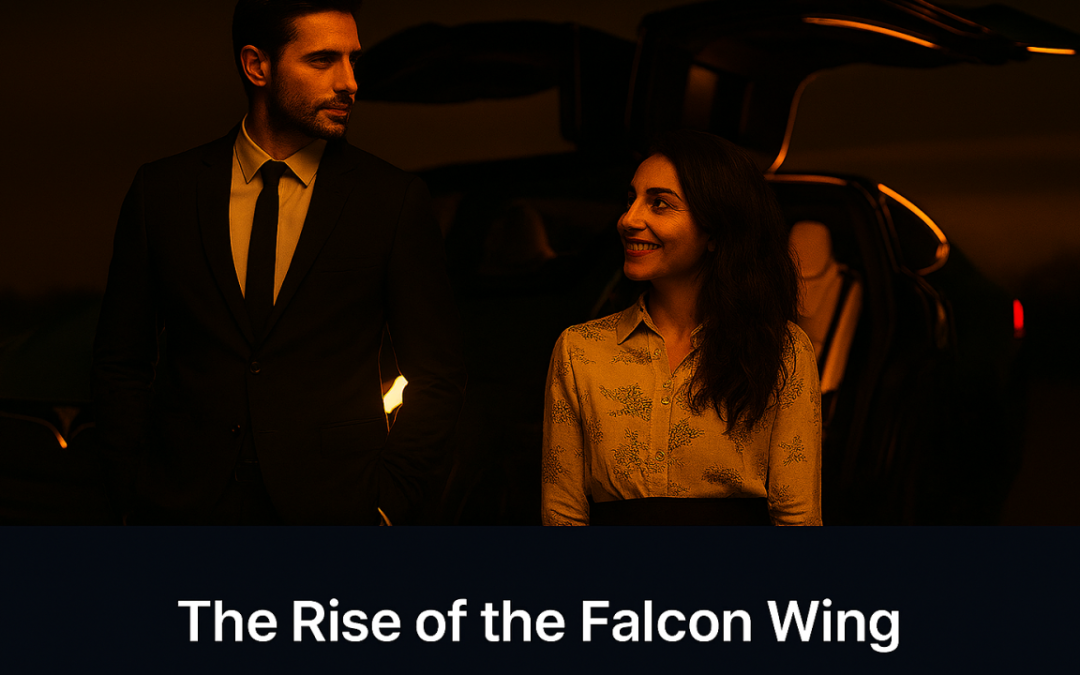
There is a moment—brief but unmistakable—when a Tesla Model X approaches, pauses, and lifts its falcon wing doors skyward. The crowd notices. Conversations stop. Phones come out.
For a split second, the car ceases to be transportation and becomes theater.
These doors don’t merely open. They announce intention. They suggest that someone, somewhere, decided the ordinary was no longer good enough.
But this story didn’t begin with Tesla. It’s a tale, decades in the making—one shaped by engineering ambition, cinematic time travel, and persistent questions about why innovation so often bends instead of breaks tradition.
The Rise of the Falcon Wing
Tesla’s Model X falcon wing doors are a modern reinterpretation of an audacious idea: doors that rise upward instead of swinging outward.
But unlike their ancestors, Tesla’s doors are not just dramatic—they are intelligent.
Using sensors, cameras, and a double‑hinged articulation system, Model X doors:
- Open vertically in tight parking spaces
- Detect walls, ceilings, and nearby obstacles
- Provide easier access to second‑ and third‑row seating
- Require less side clearance than traditional doors
This is not spectacle for spectacle’s sake. It’s theater backed by software.
Yet to appreciate why this matters, we need to rewind.
Before Falcon Wings: The Birth of the Gull‑Wing Door
The gull‑wing door predates modern EVs by decades.
Its most famous early appearance came in the 1954 Mercedes‑Benz 300SL, where the doors were born not from aesthetics, but necessity. The car’s tubular space frame required high side sills for rigidity—traditional doors simply wouldn’t work.
Opening upward solved the problem elegantly.
Then came the cultural lightning strike.

The DeLorean DMC‑12 and Cultural Immortality
In 1981, the DeLorean DMC‑12 arrived, stainless steel skin gleaming, gull‑wing doors raised like mechanical wings. On its own, it was bold. But once Back to the Future hit theaters in 1985, it became mythology.
The DeLorean transformed gull‑wing doors into:
- A symbol of futurism
- A shorthand for innovation
- A vehicle literally capable of breaking time
To this day, people who’ve never seen a 300SL know gull‑wing doors because of Doc Brown and 88 miles per hour.
Popularity surged—but adoption didn’t.
Why?

Falcon Wing vs. Gull‑Wing: Similar Dreams, Different Realities
Though often conflated, falcon wing doors and gull‑wing doors are not the same.
Traditional Gull‑Wing Doors (DeLorean, 300SL)
- Single hinge mounted at the roof
- Entire door lifts upward
- Require significant overhead clearance
- Can be heavy and structurally complex
- Challenging for emergency egress if upside down
Tesla Falcon Wing Doors
- Double‑hinged
- Fold as they rise
- Require less vertical and lateral clearance
- Actively adapt to surroundings
- Enable access to rear seats without swinging wide
In short:
Gull‑wing doors are bold mechanical statements. Falcon wing doors are bold mechanical statements enhanced by AI.
Why These Doors Are Actually Better Than Traditional Doors
Beyond spectacle, upward‑opening doors solve real problems:
✅ Tight parking lots – No door dings
✅ Improved ingress/egress – Especially for families, children, and aging passengers
✅ Better rear‑seat access – Particularly for third rows
✅ Clear visual identity – Instantly recognizable
This isn’t novelty—it’s design aligned with human behavior.
And yet…
A Brief (Humorous) Aside: Suicide Doors
At this point, we must acknowledge the odd cousin in the door family tree: suicide doors.
Rear‑hinged doors earned their dramatic name because, historically, if one opened at speed, airflow could rip it wider—and potentially pull a passenger out. Not ideal. Not recommended. Memorable, though.
Modern engineering has made them safer, but upward‑opening doors solved the “wow” problem without flirting with physics-induced chaos.
Progress.

So Why Haven’t Winged Doors Taken Over the World?
If gull‑wing and falcon wing doors are so compelling, why aren’t they everywhere?
The answer is pragmatic—not ideological.
1. Cost and Complexity
Upward doors demand:
- Reinforced roofs
- Advanced hinges
- Stronger materials
- More testing
Most mass‑market vehicles optimize for cost, not drama.
2. Weight and Efficiency
Traditional doors are lighter and simpler. In fuel‑driven cars, every pound mattered. EVs changed that equation—but only recently.
3. Safety Regulations
Upward‑opening doors must satisfy rollover, egress, and fire‑safety requirements across global markets. It’s doable—just not easy.
4. Conservatism in Automotive Design
Cars are one of the most regulated consumer products on Earth. Innovation tends to arrive incrementally, not explosively.
Tesla ignored that rule.
Why They’re Rising Again
What changed?
- Electric vehicle platforms allow new structural architectures
- Advanced sensors and software reduce risk
- Cultural nostalgia (thank you, Back to the Future)
- Consumers demanding differentiation, not sameness
Falcon wing doors work today because technology finally caught up with imagination.
The Real Meaning of Doors That Rise
Upward‑opening doors aren’t just about entry and exit.
They are about intent.
They tell the world:
“We didn’t accept the default. We asked what else was possible.”
In business, in engineering, and in leadership—that mindset matters far more than the hinges.
Sometimes progress doesn’t arrive quietly.
Sometimes… it opens upward.
