
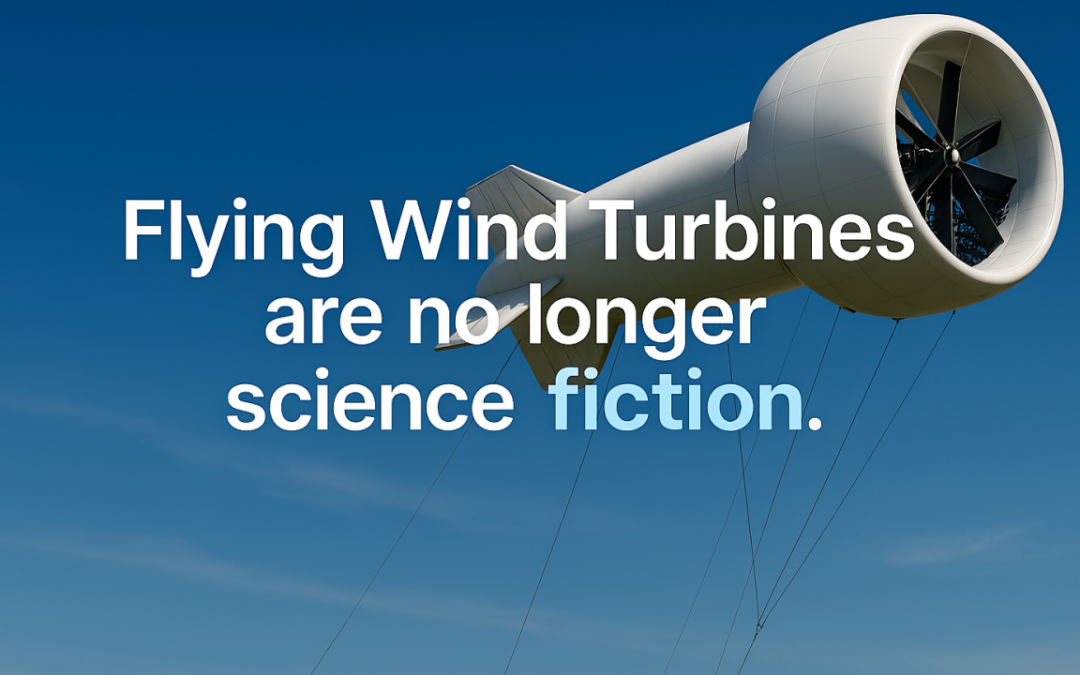
A Global Energy Innovation Is Taking Flight
The energy transition is no longer just about scaling known technologies—it’s about expanding the boundaries of what’s possible.
Wind energy has been a pillar of decarbonization for decades. But today, innovation is no longer limited to bigger blades or taller towers.
Instead, a new frontier is emerging: flying wind turbines, also known as airborne wind energy systems.
And while recent headlines have highlighted China’s progress, the reality is far more compelling:
This is not a single-country breakthrough—it’s a global innovation movement.

🌍 Airborne Wind Energy: A Worldwide Push
More than 60 organizations globally are now developing airborne wind technologies.
Across regions, different approaches are being tested:
- Kite-based systems pulling ground generators
- Airborne turbines suspended by balloons or airships
- Autonomous aircraft flying controlled patterns
All share a common goal:
👉 Capture stronger, more consistent winds at higher altitudes
🚀 China: Driving Scale and Commercial Momentum
China is currently pushing airborne wind systems closer to industrial reality.
Recent developments include:
- Megawatt-class airborne platforms capable of ~1 MW output
- Systems operating at altitudes approaching 2,000 meters
- Large-scale energy kites generating meaningful electricity per cycle
These systems aim to:
- Reduce material usage
- Lower installation and generation costs
- Expand wind deployment into difficult terrain
👉 China’s role is clear: accelerating scale and commercialization
🇪🇺 Europe: Building the Innovation Ecosystem
If China is scaling, Europe is structuring the industry.
Across the EU, startups, universities, and governments are collaborating to move airborne wind from pilot to market.
Examples include:
- Kitepower (Netherlands) Portable systems deployable in under a day, ideal for remote power
- Ampyx Power (Netherlands) Aircraft-like systems flying autonomously to generate energy
- EnerKíte & SkySails (Germany) Commercial-scale kite systems already producing real electricity
Europe is also advancing:
- Regulatory approvals for airspace integration
- Coordinated research initiatives
- A pipeline from prototype → demonstration → commercialization
👉 Europe’s role: innovation, integration, and standardization
🇺🇸 United States: The Original Pioneer
The U.S. has played a foundational role in airborne wind energy.
Key efforts include:
- Early development of airborne turbine systems through aerospace-driven design
- Companies like Altaeros and Windlift pushing portable and balloon-based solutions
- Federal research support exploring long-term viability
While commercialization has been uneven, the U.S. remains: 👉 A technology originator with strong R&D influence
🌏 Emerging Markets and Early Adoption Use Cases
Outside the major regions, airborne wind is gaining traction where traditional infrastructure is challenging.
Promising use cases:
- Island nations with limited land and high fuel costs
- Remote communities lacking grid access
- Disaster recovery and temporary power deployment
In these environments, airborne wind offers something unique:
👉 Energy without heavy infrastructure
⚙️ Traditional Wind vs. Flying Wind
To understand the opportunity, it helps to compare directly.
Traditional Wind Turbines
- Mature and widely deployed
- Efficient, reliable, and cost-effective
- Limited to near-surface wind conditions
Airborne Wind Systems
- Operate hundreds to thousands of meters above ground
- Access stronger, more consistent winds
- Require significantly less material and infrastructure
The Trade-Off
Advantages of Airborne Wind
- Higher potential capacity factor
- Rapid deployment capability
- Lower material footprint
Challenges to Overcome
- Airspace regulation and safety
- System reliability in extreme conditions
- Long-term durability of tethered systems
🔄 Parallel Innovation: Rethinking Turbine Design
Not all wind innovation is happening in the sky.
3D and vertical-axis wind turbines are rethinking how wind is captured:
- Capture wind from any direction
- Perform better in turbulent environments
- Allow closer spacing within wind farms
👉 If airborne wind expands vertically, these designs improve efficiency horizontally
🌊 Offshore Wind: Expanding Outward
While airborne systems move upward, offshore wind is moving outward.
Fixed-Bottom Offshore Wind
- Installed in shallow waters
- Proven, cost-effective technology
- Limited to certain geographies
Floating Offshore Wind
- Operates in deep water far from shore
- Accesses stronger and more consistent winds
- Unlocks vast new areas for energy generation
👉 Offshore wind expands where we build 👉 Airborne wind expands where we can reach
📊 A New Multi-Layered Wind Strategy
Wind energy is evolving into a multi-layer system:
- Surface Layer – Onshore Wind The most mature and cost-effective foundation
- Offshore Layer – Fixed & Floating Wind Enables large-scale generation beyond land constraints
- Spatial Optimization – Advanced Turbine Designs Improves efficiency and density of wind farms
- Atmospheric Layer – Airborne Wind Unlocks high-altitude wind resources with minimal infrastructure
⚡ Final Perspective: The Future of Wind Is Multidimensional
The future of wind energy isn’t about choosing one technology over another.
It’s about stacking them together.
We’re seeing a clear global pattern emerge:
- The U.S. pioneered airborne concepts
- Europe is refining and integrating them
- China is scaling toward commercialization
And together, they are reshaping how we think about wind energy.
💬 Closing Thought
Flying wind turbines are no longer science fiction.
They are an early-stage—but rapidly advancing—part of the global energy mix.
The real question isn’t whether they will play a role…
It’s:
Where will they deliver the most value first?
- Remote regions?
- Offshore energy systems?
- Utility-scale generation near the grid?

I’d be interested to hear perspectives from others in energy, infrastructure, and innovation—where do you see airborne wind fitting into the future energy mix?