
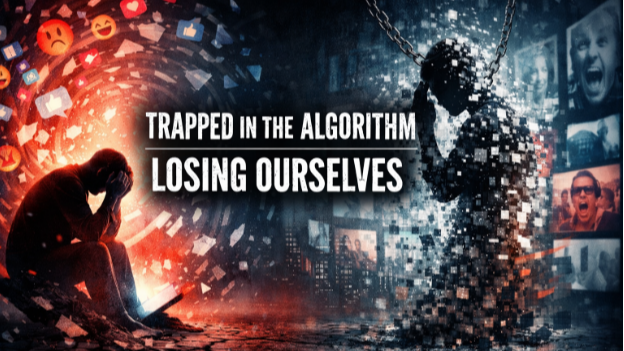
We are living through a quiet crisis — not of politics, economics, or public health, but of identity itself. Every day, billions of people step into algorithmic arenas where the rules are invisible, the incentives are emotional, and the rewards go to whoever can perform the most compelling version of their own suffering. In this new digital order, grievance travels faster than truth, fragility outperforms resilience, and victimhood becomes a kind of currency. What we’re witnessing is nothing less than the technological re‑engineering of the human self, and the consequences reach far beyond our screens.
Abstract
Contemporary digital platforms have transformed identity formation, political discourse, and psychological development. Scholars across psychology, sociology, media studies, and philosophy have identified a convergent pattern: algorithmic environments incentivize grievance, amplify fragility, and erode personal agency. This article synthesizes the work of Arthur Brooks, Jonathan Haidt, Sherry Turkle, Zeynep Tufekci, Christopher Lasch, Michel Foucault, Byung-Chul Han, and Martha Nussbaum to argue that victim‑identity politics is not merely a cultural phenomenon but a technologically engineered one. Through attention economies, algorithmic amplification, and the platformization of selfhood, digital systems structurally reward narratives of harm and disempowerment. Rebuilding agency in the digital age requires both cultural and technological reform, as well as new frameworks for digital literacy, psychological resilience, and identity self-authorship.
1. Introduction: Identity in a Technologically Mediated World
The rise of digital platforms has reshaped how individuals understand themselves, relate to others, and participate in public life. Across disciplines, scholars have observed a shift toward externalized identity, algorithmic validation, and performative grievance. While Arthur Brooks emphasizes the psychological importance of agency, his concerns resonate with broader academic critiques of digital culture.
This article argues that victim‑identity politics is not simply a sociopolitical trend but a structural consequence of digital architectures. Social media platforms reward emotional intensity, moral drama, and narratives of harm, creating an environment where victimhood becomes a strategic identity position. Integrating multiple scholarly perspectives, this article examines how technology produces and amplifies this dynamic.
2. The Psychological Foundations: Agency, Fragility, and Learned Helplessness
2.1 Arthur Brooks: Agency and Human Flourishing
Brooks argues that agency—the belief that one’s actions shape one’s future—is essential for well‑being. Victim‑identity politics undermines agency by encouraging individuals to define themselves through harm rather than capability. His framework provides a psychological foundation for understanding how digital environments can erode self‑authorship.
2.2 Jonathan Haidt: Digital Fragility and Adolescent Vulnerability
Haidt’s research on youth mental health demonstrates that social media fosters structural fragility, external locus of control, and heightened emotional reactivity. Platforms reward vulnerability and grievance, reinforcing patterns of learned helplessness.
Expand with Haidt’s digital fragility. Together, Brooks and Haidt show that digital environments weaken the psychological conditions necessary for agency.
3. The Sociological Dimension: Identity as Performance
3.1 Sherry Turkle: The Presentation of Self in Digital Life
Turkle’s work reveals how digital platforms transform identity into a performance optimized for audience reaction. Online selves are curated, fragile, and dependent on external validation.
3.2 Christopher Lasch: The Culture of Narcissism
Lasch’s analysis of therapeutic culture anticipates the rise of victimhood as moral currency. He argues that modern society encourages individuals to seek recognition through narratives of suffering. Digital platforms intensify this dynamic by monetizing attention and emotional display.
Turkle and Lasch together show that identity has become increasingly externalized and performative, setting the stage for victimhood to become a socially rewarded posture.
4. The Technological Architecture: Algorithms and Attention Economies
4.1 Zeynep Tufekci: Algorithmic Amplification and Moral Drama
Tufekci demonstrates that algorithms privilege high‑arousal content—outrage, grievance, and moral conflict. Victimhood narratives spread rapidly because they generate moral urgency and emotional engagement.
4.2 Byung-Chul Han: Psychopolitics and the Pressure of Visibility
Han argues that digital capitalism demands constant self-exposure, turning identity into a product. In this environment, victimhood becomes a counter‑identity that relieves performance pressure while still generating engagement.
Together, Tufekci and Han show that victim identity is not merely culturally rewarded—it is algorithmically engineered.
5. The Political and Philosophical Dimension: Power, Emotion, and Discourse
5.1 Michel Foucault: Identity and Discursive Power
Foucault’s theory of power explains why victimhood becomes a dominant identity category. Platforms shape which identities are visible, legible, and rewarded. Victimhood becomes a discursive position that grants moral authority within digital systems.
5.2 Martha Nussbaum: Political Emotion and Moral Status
Nussbaum’s work on anger and political emotion shows that narratives of harm generate moral status and political mobilization. Social media amplifies these emotions, making victimhood a powerful political identity.
Foucault and Nussbaum together reveal that victim identity is not only psychologically compelling but politically advantageous.
6. Synthesis: Victimhood as a Technologically Engineered Identity
Across disciplines, a clear pattern emerges:
- Psychology (Brooks, Haidt): Digital environments erode agency and foster fragility.
- Sociology (Turkle, Lasch): Identity becomes performative and externally validated.
- Technology Studies (Tufekci, Han): Algorithms reward grievance and emotional intensity.
- Philosophy (Foucault, Nussbaum): Victimhood becomes a discursive and emotional position of power.
These perspectives converge on a single conclusion: Victim‑identity politics is not merely cultural—it is structurally produced by digital platforms.
Social media transform’s identity into content, grievance into currency, and fragility into engagement. The result is a technologically mediated crisis of agency.
7. Rebuilding Agency in a Digital Age
Reversing this trend requires interventions at multiple levels:
7.1 Psychological Interventions
- Agency training
- Narrative reframing toward capability
- Resilience education for youth
7.2 Sociocultural Interventions
- Reclaiming private identity spaces
- Promoting earned success over algorithmic validation
7.3 Technological Interventions
- Algorithmic transparency
- Designs that reward constructive engagement
- Digital hygiene practices
7.4 Political and Institutional Interventions
- Discouraging grievance-based mobilization
- Promoting civic agency and responsibility
8. Conclusion: Agency as a Technological Imperative
The interdisciplinary evidence is clear: digital platforms have reshaped identity formation in ways that structurally reward victimhood and undermine agency. The crisis of agency is not merely psychological or cultural—it is technological. Rebuilding agency requires rethinking the architectures of digital identity, the incentives of attention economies, and the emotional dynamics of online discourse
In the algorithmic age, agency is not only a virtue.
It is a necessity.