
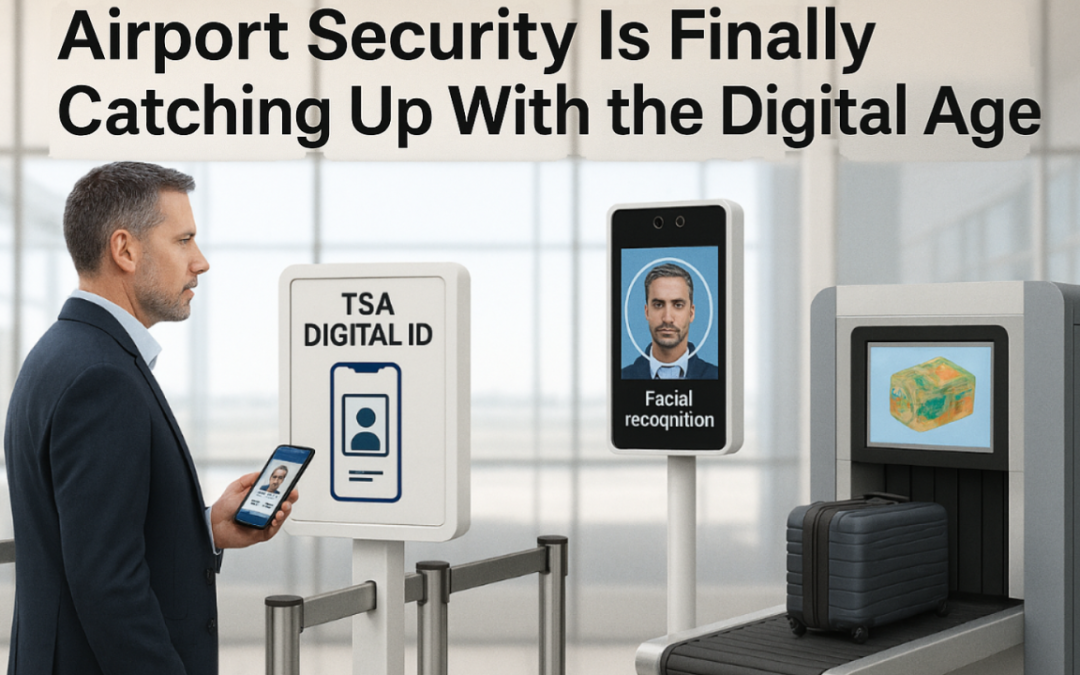
For decades, airport security has been defined by friction: long queues, repetitive identity checks, and the familiar choreography of unpacking laptops and electronics in public. That experience is now undergoing its most significant transformation since the creation of the Transportation Security Administration.
A convergence of digital identity, biometric verification, and advanced screening technology is reshaping how travelers move through airports. The promise is compelling: faster lines, stronger security, fewer touchpoints, and a process that finally acknowledges how modern travelers live and work.
Yet every major infrastructure shift carries consequences beyond its original intent. As airport security modernizes, it deserves not only celebration—but scrutiny.
The New Foundations of Modern Airport Security
Digital IDs: Identity Moves to the Device
The expansion of digital identification is one of the most visible changes at U.S. airports. Many travelers can now present a mobile driver’s license or state ID stored securely in Apple Wallet, Google Wallet, Samsung Wallet, or a state‑issued app. At participating airports, identity verification can occur via encrypted data exchange rather than a physical document.
The benefits are tangible: reduced document fraud, faster processing, and less reliance on manual inspection under time pressure. Importantly, participation remains voluntary, and travelers are still encouraged to carry physical ID as a backup.
Still, this marks a meaningful conceptual shift. Identity verification becomes data‑driven rather than document‑driven, and authentication increasingly happens between devices and systems rather than people.

Facial Recognition: Touchless Verification at Scale
Facial recognition has quietly become a core component of modern checkpoint infrastructure. TSA’s Credential Authentication Technology (CAT‑2) systems and TSA PreCheck Touchless ID lanes allow opt‑in travelers to verify identity using a live facial scan matched to an existing government image, such as a passport photo.
For frequent flyers, the experience can feel almost invisible—no ID, no boarding pass, just a brief glance at a camera. From an operational standpoint, this reduces bottlenecks and allows security personnel to focus on situational awareness rather than paperwork.
TSA maintains that biometric participation is optional and that images are deleted after verification. These assurances matter, because facial recognition’s power lies in its scalability.

CT Bag Scanners: Ending the Laptop Shuffle
Perhaps the most traveler‑friendly upgrade is the deployment of computed tomography (CT) scanners at airport checkpoints. These machines generate high‑resolution, rotatable 3‑D images of carry‑on bags, enabling automated algorithms to detect threats with far greater accuracy than legacy 2‑D X‑ray systems.
In CT‑equipped lanes, passengers can usually leave laptops, tablets, and other large electronics inside their bags—a seemingly small change that significantly reduces congestion and stress. Over 250 U.S. airports now operate CT scanners, with wider rollout planned over the coming years.

Why These Technologies Are Being Deployed Together
Viewed individually, each of these upgrades improves a specific step in the screening process. Together, they form a coherent model:
- Digital IDs verify who you claim to be
- Facial recognition confirms you are the rightful holder of that identity
- CT scanners assess what you are carrying
The result is a system that relies less on hurried human judgment and more on consistent, machine‑assisted analysis. In theory, this increases both security and fairness.
But technology does not exist in a vacuum. How it is governed—and how deeply society comes to rely on it—determines whether it remains a tool of safety or evolves into something more intrusive.
When Convenience Becomes Infrastructure
Every generation of security technology begins with practical goals: reduce risk, increase efficiency, and lower the burden on both travelers and operators. When those goals are achieved, success creates a new dynamic—dependence.
Once systems work well, alternatives fade. Staff are trained exclusively on the new tools. Budgets assume their constant availability. Manual processes are de‑emphasized or abandoned entirely. Opt‑outs remain technically possible, but operationally inconvenient.
This pattern is not unique to aviation. Similar trajectories can be seen elsewhere:
- Credit scoring, once limited to lending, now affects housing, employment, and insurance eligibility.
- Smartphone authentication started as convenience and now gates access to banking, healthcare portals, and government services.
- Algorithmic moderation introduced for safety now shapes visibility, reach, and participation across digital platforms.
In each case, the risk did not arise from malice—but from over‑reliance on systems whose scope expanded faster than their oversight.

Early Warning Signs in Identity and Biometric Systems
Even within democratic systems, edge cases reveal how fragile trust can be if governance lags:
- False positives in facial recognition have resulted in delayed travel, secondary screening, and legal challenges.
- System outages have halted screening operations when legacy manual processes were no longer adequately staffed.
- Vendor concentration has placed core public‑safety infrastructure in the hands of a small number of private companies, limiting transparency.
- Normalization of surveillance has altered expectations, making constant identity verification feel routine rather than exceptional.
Individually, these incidents are manageable. Collectively, they signal a deeper structural risk: systems designed for verification can gradually shift toward evaluation.
From Verification to Evaluation
Verification asks a simple question: “Are you who you claim to be?”
Evaluation asks something different: “Given your history, should you be allowed access?”
Once systems begin to evaluate trustworthiness rather than identity alone, incentives and penalties follow. Access may be delayed, restricted, or denied—not because a law was broken, but because risk thresholds have changed.
In narrow contexts like fraud prevention, this can be effective. At scale, across domains, it can shape behavior rather than merely assess it.
This global pattern provides the necessary context to understand why one country is so often referenced in these discussions—not as a warning of inevitable outcomes, but as an example of what happens when this trajectory plays out fully.
Why China Becomes the Case Study
China did not leap directly into a surveillance‑heavy society. Its current systems evolved incrementally, layered atop rapid digitization, cashless payments, weak legacy credit infrastructure, and aggressive urban modernization.
What makes China instructive is not a single program, but the degree of integration.
Administrative data, court rulings, transit access, financial compliance, and facial recognition cameras gradually converged into interconnected systems designed to promote “trustworthiness.” Facial recognition became the bridge between physical behavior and digital records, enabling automated consequences.
Over time, this convergence allowed security and administrative systems to influence daily life in ways far beyond their original scope:
- Travel restrictions tied to non‑criminal violations
- Public blacklisting affecting employment and education
- Automated enforcement replacing human discretion
- Behavioral incentives embedded into routine decision‑making
Notably, none of this required fictional technology or abrupt authoritarian shifts. It emerged through policy accumulation, justified step by step by efficiency, order, and public interest.
China represents not a technological outlier, but a completed version of a spectrum many societies are only beginning to explore.
The Difference—and the Caution
Western democracies operate under different legal, cultural, and constitutional frameworks. Airport biometric programs in the U.S. and Europe remain voluntary, limited in scope, and subject to judicial and legislative oversight.
That distinction matters. But infrastructure is durable in ways policy is not.
Once systems become foundational, future leaders inherit their capabilities—regardless of whether they share the values of those who deployed them.
The question, then, is not whether modern airport security resembles China’s systems. It does not. The question is whether today’s guardrails are strong enough to prevent gradual convergence under future political, economic, or security pressure.
Progress With Memory
Modern airport security should be faster, safer, and less invasive than the past. Digital IDs, facial recognition, and CT scanning deliver real improvements that travelers can feel today.
But resilience is not just about stopping threats. It is about ensuring that systems designed for protection cannot be silently repurposed.
The value of studying cases like China is not fear—it is foresight. They illuminate the far end of a path we have only begun walking.
And foresight, unlike technology, cannot be automated.
