
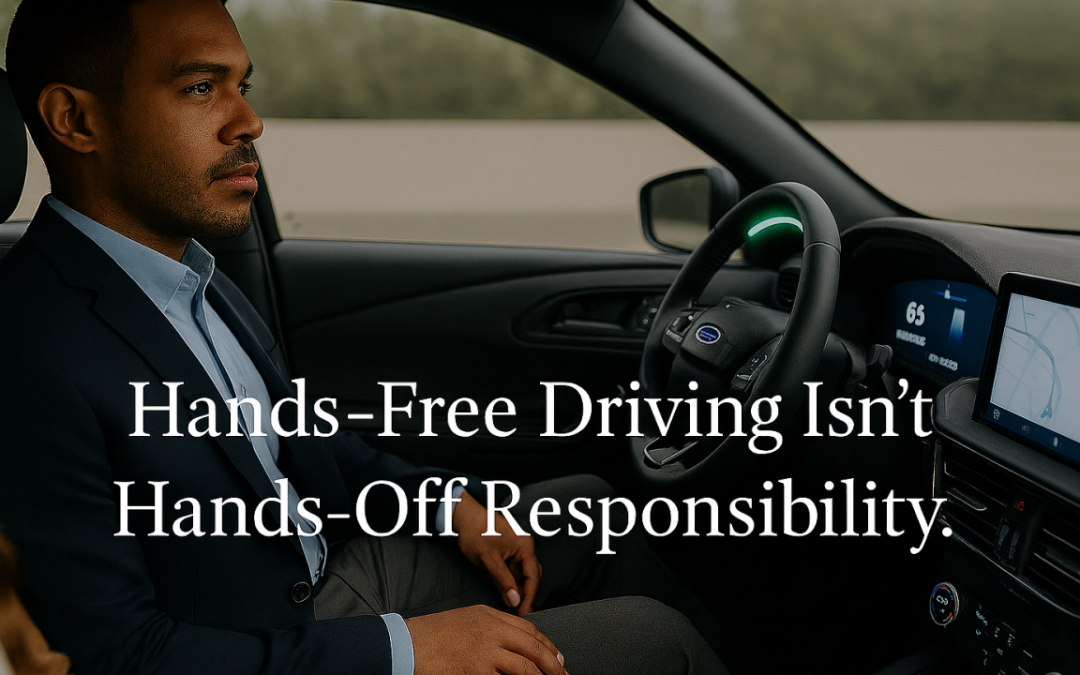
We are living through a subtle but profound shift in how cars are driven—and how drivers interact with them. Hands‑free driving has moved from novelty to normalized feature on highways across the U.S., and at the same time, the dashboard itself is evolving into a full‑fledged software platform. Together, these trends are reshaping the role of the driver, the responsibility of the vehicle, and the very definition of the driving interface.
The end result is not autonomy—at least not yet—but a careful rebalancing of work between human and machine.
What “Hands‑Free” Really Means in 2026
Modern hands‑free systems like GM Super Cruise and Ford BlueCruise allow drivers to remove their hands from the steering wheel for extended periods on approved highways. The car manages steering, acceleration, and braking simultaneously, often with remarkable smoothness.
But it is critical to understand what these systems are—and what they are not.
They are not self‑driving cars. They are advanced driver‑assistance systems designed to reduce workload, not responsibility. The driver remains fully accountable and must be ready to intervene instantly. Hands‑free driving today is better described as hands‑off, eyes‑on.
That distinction is enforced technically, not just legally.
Continuous Attention Is No Longer Optional
Unlike older driver assistance systems that merely checked for torque on the steering wheel, today’s hands‑free modes actively monitor the driver. A driver‑facing camera—often infrared and capable of working in darkness or with sunglasses—tracks head position, eye gaze, and attention patterns.
If the system detects that the driver is looking away from the road for too long, it responds in stages:
- Visual prompts
- Audible alerts
- Escalating warnings
- Eventual system disengagement if the driver fails to respond
This isn’t about punishment—it’s about trust calibration. The technology is designed to ensure the human remains cognitively in the loop, especially since these systems still have limits around construction zones, weather, and unpredictable road behavior.

The Steering Wheel as a Status Display
One of the most effective safety choices made by automakers has nothing to do with cameras or AI—it’s the light on the steering wheel.
Rather than burying system status in menus or dashboards, hands‑free systems communicate their state directly through a light bar or illuminated indicator that sits in the driver’s line of sight.
- Green typically means hands‑free mode is active
- Flashing green or blue signals reduced attention or transitional states
- Red alerts the driver to immediately retake control
This elegant visual language removes ambiguity. You always know who is in charge—you or the car—and when responsibility is about to shift.
Importantly, drivers cannot engage these systems passively. Hands‑free mode requires explicit activation through steering‑wheel controls, reinforcing awareness and intent. You don’t “fall into” hands‑free driving; you choose it.
A Parallel Shift: The Dashboard Becomes Its Own Platform
While driving assistance quietly improves in the background, the dashboard itself has undergone a more visible transformation.
What was once a simple display tethered to your phone is now becoming a stand‑alone software environment—complete with native apps, persistent connectivity, and its own interaction model.
Increasingly, cars ship with:
- Built‑in navigation apps
- Native streaming audio and podcast apps
- Charging, fueling, and route‑planning tools
- Vehicle‑specific apps for efficiency, towing, or drive modes
- Integrated voice assistants that operate at the system level
These apps don’t depend on your phone being plugged in. They live in the vehicle, understand the vehicle, and are designed around the realities of motion, attention, and safety.
Not a Phone on Wheels—A Purpose‑Built Interface
This is a critical difference. Automotive dashboards are not trying to replicate smartphones.
They are curated, constrained, and intentional. App selection is limited by design, prioritizing:
- Large, glanceable UI elements
- Voice‑first interaction
- Context‑aware availability
- Reduced visual and cognitive load
Some apps disappear or change behavior when hands‑free driving is active. Others—navigation, alerts, audio—become more prominent. The system adapts to the driving state rather than demanding constant interaction.
In this sense, the modern dashboard resembles a cockpit more than a tablet.
Decoupling the Phone From the Driving Experience
As dashboards gain autonomy, the phone’s role diminishes. Drivers no longer need to manage cables, pairing behavior, or projections just to access core features. Preferences, subscriptions, and profiles increasingly live in the car itself, synced through the cloud rather than mirrored from a device.
This shift reduces cognitive friction. The interface behaves consistently every time you sit down, regardless of who’s carrying which phone.
Ironically, as automation increases, the system is designed to feel quieter, not louder—present when needed, invisible when not.
One Unified Direction: Less Effort, More Awareness
Hands‑free driving and app‑centric dashboards are not separate trends. They are complementary expressions of the same philosophy:
- Reduce unnecessary physical effort
- Preserve—and even heighten—situational awareness
- Communicate system intent clearly
- Keep the human meaningfully engaged
The glow of a green steering wheel and a calm, purpose‑built dashboard are not signs that the driver has been replaced. They are signs that the car is learning how to assist without distracting, and how to inform without overwhelming.
We are not yet at a future where drivers can disengage entirely—and perhaps that’s intentional. In 2026, the most advanced cars aren’t those that remove the human from the loop. They’re the ones that understand exactly where the human still belongs.