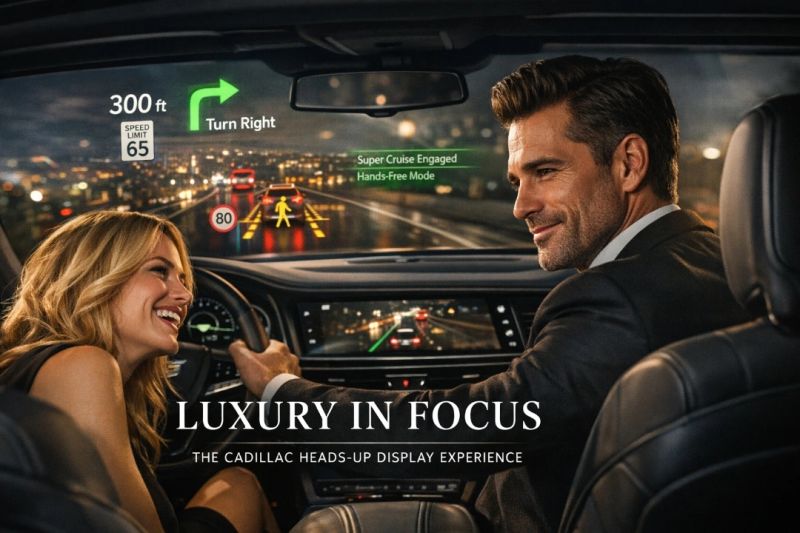
As vehicles become more software‑defined, one feature is emerging as a new differentiator in the luxury segment: the heads‑up display (HUD). With laser‑based HUD technology entering the market, the windshield is quickly becoming the most valuable digital real estate in the vehicle.
Why HUDs Matter in 2026
HUDs reduce distraction by projecting key information — speed, navigation, safety alerts — directly into the driver’s line of sight. The benefits are clear:
– Faster reaction times
– Less eye movement away from the road
– A more intuitive, premium UX
In a world filled with screens, HUDs simplify rather than overwhelm.
Cadillac’s Approach: Clarity Over Gimmicks
Cadillac has quietly built one of the most balanced and driver‑centric HUD experiences in the luxury market. Across models like the CT5, XT6, and Escalade, Cadillac’s HUDs are known for:
– High brightness and visibility
– Clean, minimal graphics
– Seamless integration with Super Cruise
BMW takes a bold, immersive approach. Their HUDs are large, colorful, and highly customizable. They offer one of the most visually dynamic experiences on the market.
Mercedes‑Benz leans heavily into augmented reality. In models like the S‑Class and EQ lineup, navigation arrows appear to float over the road itself. It’s visually stunning and extremely advanced.
Audi stays true to its minimalist design language. Audi HUDs are clean, simple, and easy to read. They’re refined and unobtrusive.
Lexus focuses on reliability and clarity. Their HUDs are bright, safety‑oriented, and consistent across the lineup. They deliver a polished experience.
Cadillac, by comparison, sits in a sweet spot. Its HUDs are more intuitive than Audi’s, less visually aggressive than Mercedes’, and more balanced than BMW’s. Cadillac prioritizes clarity and driver confidence over visual theatrics — a choice many drivers appreciate.
The Next Leap: Laser‑Based HUD Technology
Traditional HUDs rely on LEDs and mirrors. The next generation — laser‑based HUDs — uses micro‑laser projection to deliver:
– Higher resolution
– Greater brightness
– Larger projection fields
– True augmented‑reality overlays
Laser HUDs can project graphics that appear tens of meters ahead, aligning digital cues with real‑world objects. This unlocks capabilities like:
– Lane‑specific navigation
– Highlighted hazards or pedestrians
– Speed limits displayed next to the actual sign
– Windshield‑wide AR guidance
Where the Market Is Going
As electrification and autonomy accelerate, HUDs will become the primary interface between drivers and vehicle intelligence systems. Laser‑based HUDs will push the industry toward:
– Fewer physical screens
– More AR‑driven guidance
– Safer, more intuitive driving
– A windshield that functions like a dynamic display
Luxury brands that master this interface will define the next era of automotive UX.
Heads‑Up Displays Are Becoming the New Luxury Benchmark