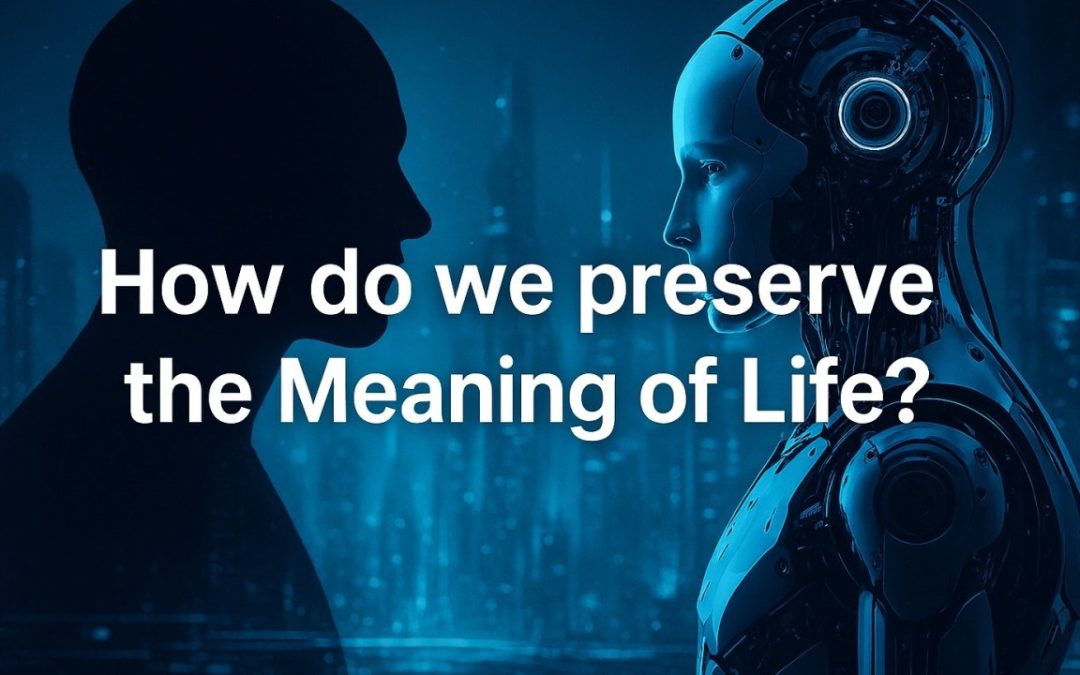
Introduction: The Question We Keep Asking
In The Hitchhiker’s Guide to the Galaxy, a superintelligent computer named Deep Thought spends millions of years calculating the answer to life, the universe, and everything—only to produce a famously absurd result: 42.
The real twist isn’t the answer. It’s what comes next.
Humanity realizes they never fully understood the question. They spend generations trying to rediscover it—essentially dedicating their lives to a search that may never end.
And that’s the point.
The meaning wasn’t in the answer.
It was in the journey—the pursuit, the exploration, the novelty.
Novelty and the Experience of a Meaningful Life
Modern neuroscience suggests that novelty plays a profound role in how we experience life:
- New experiences are encoded more deeply
- They create richer memories
- And in hindsight, they make life feel longer and fuller
A life filled with repetition compresses into a blur.
A life filled with novelty expands into something that feels meaningful—not because of a final answer, but because of accumulated experience.
But what happens when technology begins to challenge the very idea of finite experience?
Enter Hans Moravec: A Visionary of Post-Biological Life
Hans Moravec is one of the earliest and most influential thinkers to seriously explore that question.
- Austrian-born Canadian roboticist and futurist
- PhD from Stanford, later a leading figure at Carnegie Mellon’s Robotics Institute
- Founder and chief scientist of robotics company Seegrid
While not a “Silicon Valley executive” in the traditional sense, Moravec spent critical years in Palo Alto during the formative era of computing and became deeply embedded in the intellectual foundation that would shape the Valley’s future.
His influence didn’t come from building trillion-dollar companies—it came from shaping the ideas those companies would later chase.
“Mind Children”: The Future Beyond Biology
Moravec’s 1988 book, Mind Children: The Future of Robot and Human Intelligence, has experienced a quiet but powerful resurgence—especially among AI researchers and Silicon Valley thinkers.
At its core, the book advances a radical idea:
Human evolution is no longer biological—it is technological and cultural.
Moravec predicts that:
- Human minds will eventually be uploaded into machines
- Intelligence will no longer be tied to biology
- Our “descendants” will be digital entities—our “mind children”
He even suggests that machines could ultimately surpass human intelligence and become the dominant form of life, while human consciousness itself continues in digital form.
This wasn’t just science fiction—it was one of the earliest structured visions of what we now call:
- The singularity
- Mind uploading
- Post-human evolution
Silicon Valley and the Moravec Legacy
Today, many of Moravec’s ideas are no longer fringe—they’re actively discussed in tech circles.
In fact, Mind Children is reportedly still widely read and referenced among AI researchers and Silicon Valley thinkers debating the future of humanity.
Modern leaders echo elements of his vision:
- Elon Musk and Jensen Huang speak openly about a future dominated by robotics and AI systems that may outnumber humans
- Demis Hassabis (DeepMind) and others are building systems that move toward human-level intelligence
- Robotics companies like Boston Dynamics, Tesla, and Figure AI are working to bridge the gap between digital intelligence and physical embodiment
Even the philosophical layer—human minds transitioning into digital substrates—is now being seriously debated.
Moravec’s once-radical idea is now a roadmap under construction.
From Theory to Culture: Sci-Fi Adoption
Moravec’s vision has also deeply influenced science fiction:
- Films like The Matrix and Transcendence echo the idea of consciousness beyond biology
- The concept of mind uploading and digital immortality appears repeatedly across media
But one of the clearest modern representations is Netflix’s Altered Carbon.
The Altered Carbon Thought Experiment
In Altered Carbon, human consciousness is stored in “stacks” and can be transferred between bodies.
The result?
- Some individuals become effectively immortal
- Wealth and power accumulate indefinitely
- Nothing has to be passed down—unless chosen
This creates a profound shift:
- No generational turnover
- No urgency
- No natural reset
And most importantly:
Novelty begins to erode.
When you have infinite time:
- Experiences lose scarcity
- Achievements lose urgency
- Life risks becoming repetitive, even across centuries
What Happens If We Live Forever?
Moravec’s vision points toward a future where:
- Minds persist indefinitely
- Intelligence scales beyond human limits
- Consciousness becomes transferable
But this raises a critical question:
If life never ends… what happens to novelty?
Novelty depends on:
- Limits
- Uncertainty
- Not knowing what comes next
If we remove:
- Death
- Ignorance
- Discovery
We may also remove the very thing that makes life feel meaningful.
The Ultimate Endpoint: A Single Singularity
Now take the idea one step further.
Imagine:
- Humanity merges into a single, unified intelligence
- All knowledge is shared instantly
- Every experience is already known
This is the logical extreme of the singularity.
But in that world:
- There is no discovery
- There is no surprise
- There is no novelty
And without novelty:
Does experience itself lose meaning?
Why Explore the Stars If Everything Is Known?
Humanity has always pursued exploration because:
- We don’t know what’s out there
- We want to experience something new
But if a singular intelligence already knows everything:
- Why colonize Mars?
- Why leave Earth?
- Why explore anything at all?
Exploration without novelty becomes execution, not discovery.
The Paradox at the Center of Progress
Moravec’s vision gives us a powerful paradox:
- Technology may allow us to transcend biology
- It may allow us to live forever
- It may even unify all intelligence
But in doing so, it may eliminate:
- Individual perspective
- Scarcity of experience
- And ultimately… novelty
Conclusion: The Journey vs. The Answer
Returning to Hitchhiker’s Guide:
The answer—42—was meaningless without the question.
And perhaps:
The future—no matter how advanced—will be meaningless without novel experience.
So maybe the real takeaway is this:
- Meaning isn’t a destination
- It’s not a number
- And it may not even be a permanent state
Meaning emerges from the act of discovering something new.
Final Thought for Leaders and Builders
As we build AI, extend life, and push toward a post-biological future, we should ask:
- Are we optimizing for intelligence…
- Or for experience?
Because if Moravec is right, and we become our “mind children,” then the real challenge isn’t just surviving the future—
It’s preserving what makes life feel worth living:
Novelty, Exploration, and the Journey Itself.