
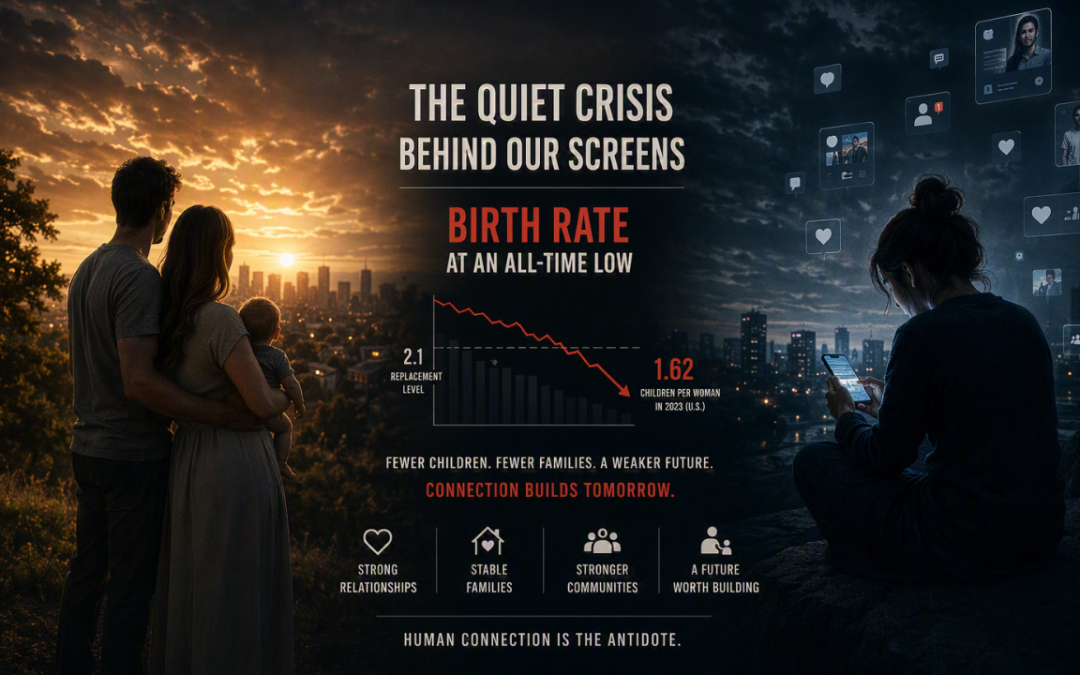
The Quiet Crisis Behind Our Screens
We live in a world overflowing with digital connection — yet starved for human connection. Messages arrive instantly, videos reach millions, and dating apps offer endless profiles. But beneath all this convenience is a growing social crisis:
- Birth rates are falling
- Marriage rates are declining
- Divorce patterns are shifting
- Loneliness is rising
- Families are harder to form
These trends aren’t happening because people stopped caring about relationships. They’re happening because technology reshaped human behavior faster than culture, community, and morality could adapt.
The Numbers: A Society Drifting Away From Connection
Birth Rates
The United States is experiencing the lowest birth rates in its history. According to the CDC’s National Vital Statistics Reports (NVSR), the U.S. total fertility rate fell to 1.62 children per woman in 2023, well below the 2.1 replacement level needed for population stability.
States like New Jersey are even lower, with fertility hovering around 1.49, based on state-level data published by the CDC and the New Jersey Department of Health. These numbers aren’t abstract. They reflect a society where fewer people feel secure enough — financially, emotionally, or socially — to start families.
Marriage Rates
Marriage has been declining for decades. The National Center for Health Statistics (NCHS) reports that the U.S. marriage rate dropped from 76 marriages per 1,000 unmarried women in 1970 to roughly 31 per 1,000 today — a decline of nearly 60%.The median age of first marriage is now 30 for men and 28 for women, according to the U.S. Census Bureau’s Current Population Survey. People aren’t rejecting marriage. They’re struggling to reach the stability needed to pursue it.
Divorce Rates
Divorce trends are more nuanced. The overall divorce rate has declined since the 1980s, but the American Community Survey shows this is largely because fewer people are marrying in the first place. Among marriages that do occur, roughly 40–45% end in divorce, according to long-term analysis from the National Survey of Family Growth (NSFG).
“Gray divorce” — divorce among adults over 50 — has doubled since 1990, according to research published by Bowling Green State University’s National Center for Family & Marriage Research.
The takeaway:
Marriage is rarer, but the marriages that exist are still fragile.
Technology: The Invisible Architect of Modern Relationships
The biggest driver of these trends isn’t cultural conflict — it’s technology.
Digital Hypergamy
One of the most powerful effects of modern dating platforms is a behavioral pattern known as digital hypergamy. This isn’t the old idea of “marrying up.”
It’s the modern version created by apps and algorithms. When people are shown endless options, algorithms push them toward the highest‑status profiles. This pattern has been documented in multiple studies, including research published in Computers in Human Behavior and data analyses from major dating platforms.
These studies consistently show:
- A small percentage of profiles receive the majority of attention
- Many users feel invisible
- Long-term connection becomes harder to form
- People perceive the dating market as more competitive than it actually is
- This isn’t anyone’s fault.
It’s a design outcome of algorithmic sorting.
Social Media
Platforms reward:
- luxury lifestyles
- curated perfection
- comparison
- short-term thinking
The Pew Research Center has repeatedly found that heavy social media use correlates with increased loneliness, anxiety, and reduced relationship satisfaction.
Attention Fragmentation
Constant notifications reduce:
- presence
- patience
- emotional depth
- the ability to build lasting connection
We’re connected to everything — except each other.
Empowerment Happened — But Connection Didn’t Follow
Empowerment gave individuals more freedom, more choice, and more independence.
These are good things. But empowerment alone doesn’t build families.
Empowerment without connection leads to:
- delayed relationships
- fragmented dating markets
- emotional burnout
- loneliness
- declining birth rates
We built a culture that celebrates independence but forgot to celebrate interdependence — the idea that strong individuals build even stronger families.
The Missing Pillar: A Culture That Values Family Again
If we want society to grow — emotionally, socially, and demographically — we need to restore the importance of family and long‑term connection.
- Not old-fashioned roles.
- Not restrictive expectations.
- Not nostalgia.
But modern family values built for a modern world:
- two empowered adults
- choosing partnership
- raising children with stability and purpose
- communities built around shared responsibility
- moral decisions that strengthen society
Family isn’t outdated. It’s foundational.
TA‑AF and the Fight for Human Connection
Movements like TA‑AF matter because they address the real root issue:
Technology is reshaping human relationships faster than culture can respond.
People feel the consequences:
- loneliness
- dating exhaustion
- lack of purpose
- unstable relationships
- declining birth rates
A New Cultural North Star
If we want a healthier future, we need a new guiding principle:
- Human connection is the antidote to a tech‑driven age.
- Not less technology.
- Not less empowerment.
- But more humanity.
- More families.
- More community.
- More purpose.
- More meaning.
- More love.
These aren’t old values. They’re eternal ones.