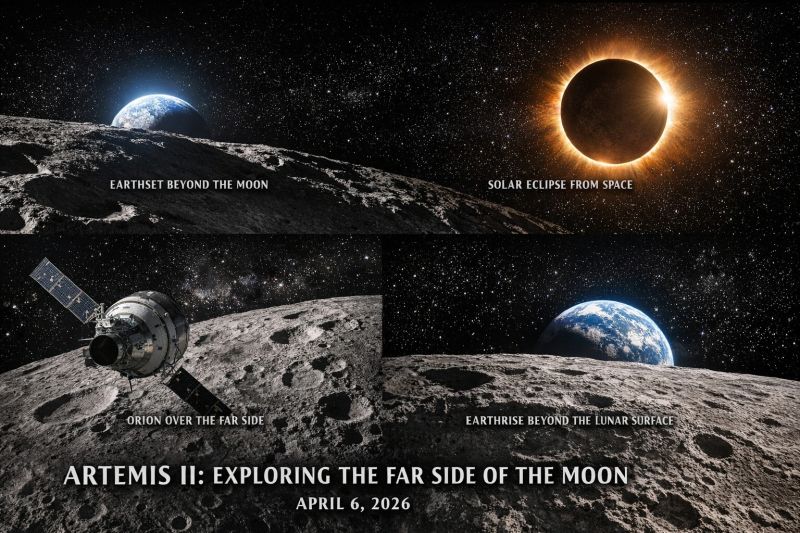
For the first time in more than half a century, NASA astronauts have once again slipped behind the Moon — out of sight, out of radio contact, and into a realm that has fascinated scientists and the public for generations. During the Artemis II mission’s seven‑hour lunar flyby on April 6, 2026, the crew captured unprecedented images and scientific observations of the Moon’s far side, marking a milestone moment in humanity’s return to deep‑space exploration.
A Hidden Hemisphere, Revealed
The Moon’s far side — often mistakenly called the “dark side” — is a hemisphere we never see from Earth due to tidal locking. Until the space age, it was a complete mystery. Even today, only a handful of humans have ever witnessed it with their own eyes.
Artemis II changed that.
As Orion slipped behind the lunar limb, astronauts Reid Wiseman, Victor Glover, Christina Koch, and Jeremy Hansen lost contact with Earth and entered a silent, breathtaking world of rugged craters, ancient lava flows, and impact scars billions of years old. NASA released a series of stunning photographs showing features like the Orientale Basin, a massive 600‑mile‑wide ringed crater straddling the boundary between the near and far sides.
Scientific Breakthroughs on the Far Side
While circling the Moon, the crew documented:
– Meteor impact flashes — brief bursts of light from space rocks striking the lunar surface.
– Terrain transitions inside craters like Vavilov, revealing smooth inner rings and jagged outer rims.
– The South Pole–Aitken Basin, the largest known impact crater in the solar system, offering clues to the Moon’s early geologic history.
These observations will help scientists refine models of lunar formation, crust evolution, and impact dynamics — foundational knowledge for future missions.
Moments of Awe: Earthset, Earthrise, and a Rare Eclipse
As Orion drifted behind the Moon, the crew witnessed Earthset — watching our planet slip behind the lunar horizon — a sight only 24 humans had ever seen before.
They also observed a rare solar eclipse from space, a moment the astronauts described as far more powerful than any simulation could prepare them for.
A New Chapter in Human Spaceflight
Artemis II didn’t just break distance records — reaching 252,756 miles from Earth, surpassing Apollo 13 — it reestablished humanity’s presence in deep space and proved that NASA’s next‑generation Orion spacecraft can safely carry astronauts around the Moon and back.
The mission’s success sets the stage for Artemis III, which aims to land astronauts near the lunar south pole — a region rich in water ice and scientific potential.
Why the Far Side Matters
Studying the Moon’s far side isn’t just about exploration — it’s about unlocking the Moon’s oldest secrets. Because this hemisphere is shielded from Earth’s radio noise.
Artemis II’s flyby marks the first step toward that future.
#NASA
NASA Finally Reaches and Studies the Backside of the Moon: A New Era of Lunar Exploration