
Abstract
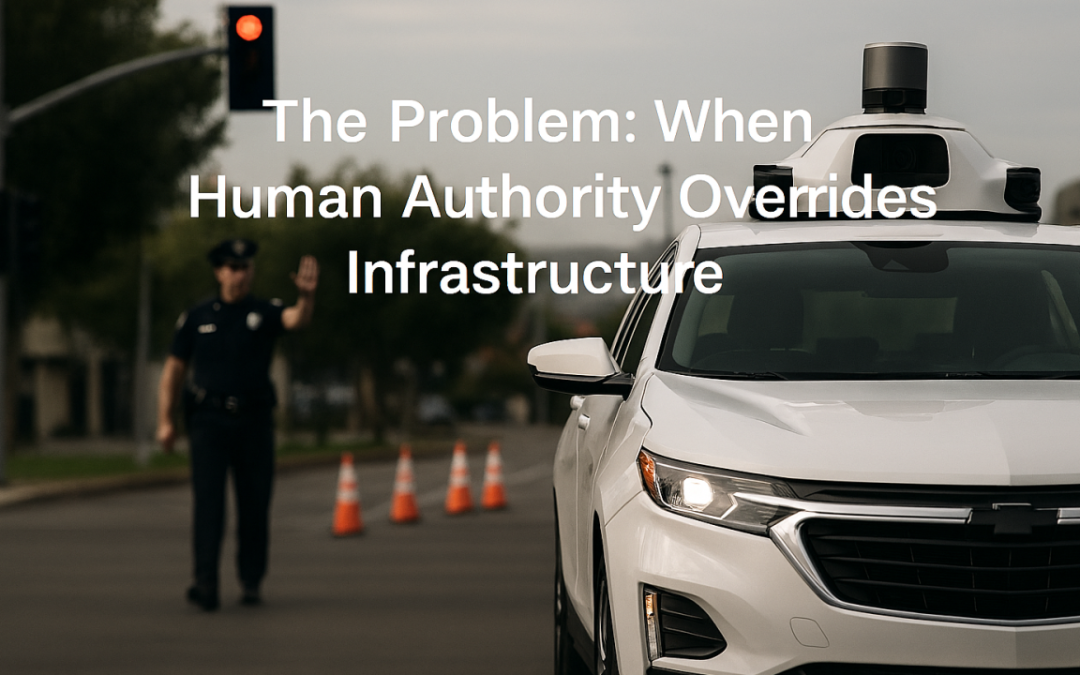
Despite substantial progress in perception, planning, and control, autonomous driving systems continue to struggle in environments governed by human authority rather than fixed infrastructure. Police‑directed traffic—where an authorized human temporarily supersedes traffic signals and signage—remains a persistent and revealing constraint. This paper argues that police‑directed traffic represents not a marginal edge case, but a structurally significant milestone for autonomous vehicles (AVs). We examine why this scenario poses a qualitatively distinct challenge, review contemporary solution strategies, and present a comparative analysis of major industry actors, including Waymo, Tesla, Cruise, Mercedes‑Benz, and Amazon’s subsidiary Zoox. We conclude that the challenge is fundamentally one of authority recognition and uncertainty management rather than perception alone, and that persistent human escalation mechanisms are likely to remain integral to safe autonomy.
1. Introduction
Autonomous driving systems now operate reliably across many structured environments, including highways and dense urban settings, within constrained operational design domains (ODDs). Nevertheless, a class of scenarios persists in which these systems exhibit hesitation, deadlock, or unsafe behavior, despite otherwise mature capabilities. Police‑directed traffic is among the most illustrative of these failures.
In such scenarios, traffic governance shifts from infrastructural signals to human authority. Traffic law in most jurisdictions explicitly grants priority to authorized traffic controllers over lights and signs. Human drivers internalize this rule through social experience and contextual reasoning. Autonomous systems, by contrast, have historically been optimized around static rule execution, exposing a mismatch between infrastructure‑centric autonomy and socially mediated control.
2. The Nature of the Challenge
2.1 Authority as a Latent Variable
At its core, police‑directed traffic requires autonomous systems to infer authority, not merely detect motion or objects. Authority is not directly observable; it must be inferred from clothing, posture, location within the roadway, environmental disruption, and behavioral consistency. This inference must be sufficiently confident to justify overriding embedded rules such as red lights or stop signs.
Traditional planning architectures, which assume fixed rule hierarchies and deterministic inputs, are poorly suited to this task.
2.2 Temporal Intent and Ambiguity
Instructional gestures from police officers are rarely instantaneous or standardized. Intent typically emerges over a sequence of actions—repeated waving, orientational cues, eye contact, and reactions to surrounding traffic. Failure to model gesture intent temporally contributes to false positives, unsafe compliance, or unnecessary conservatism.
This temporal ambiguity is compounded by visibility constraints, protective equipment, and non‑uniform global conventions.
3. Emerging Technical and Operational Solutions
Across the industry, solutions are converging around layered strategies rather than singular model improvements:
- Explicit authority detection prior to gesture interpretation.
- Temporal intent modeling using pose sequences rather than frame‑based classification.
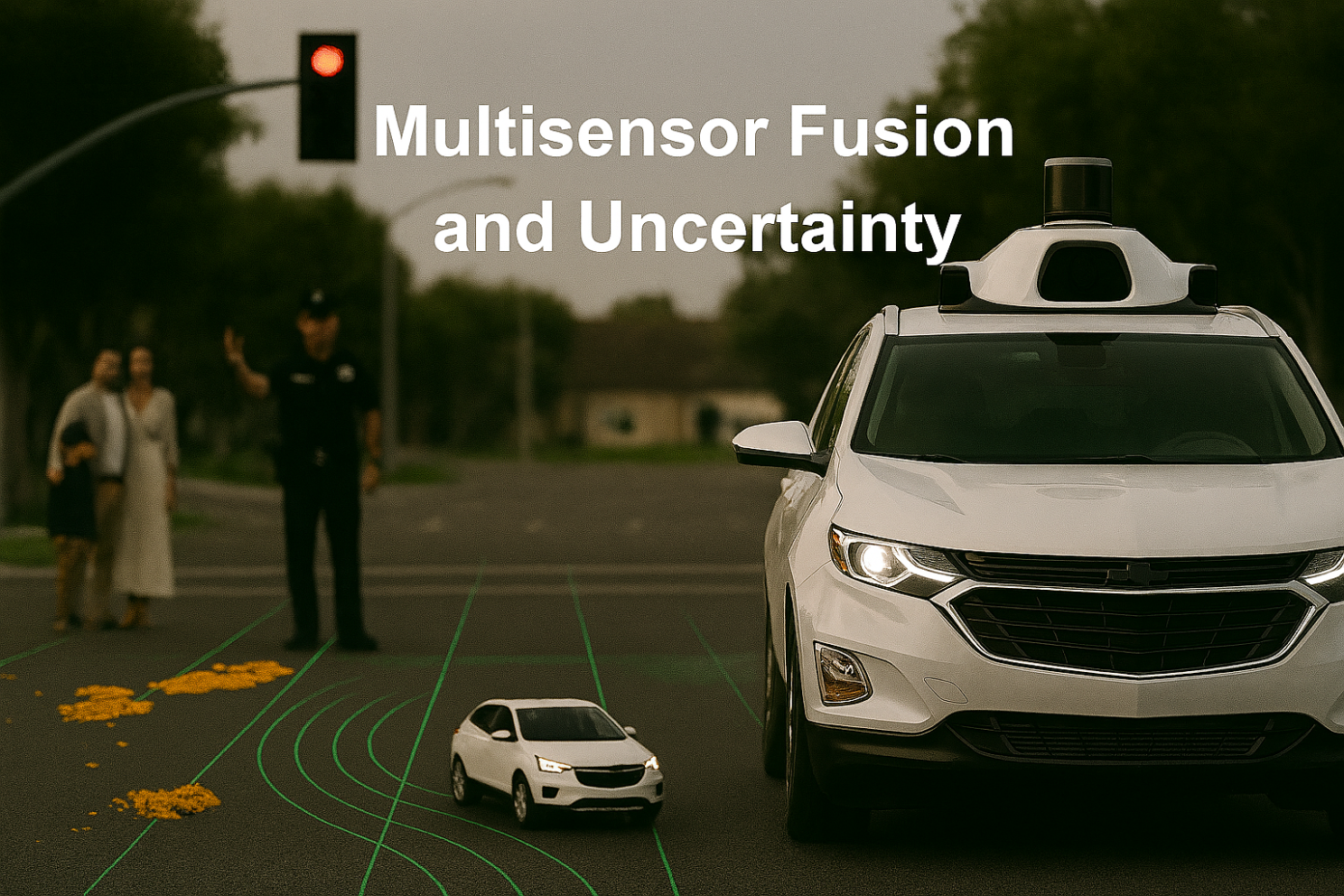
- Multi‑modal validation, combining vision, lidar, radar, and traffic flow behavior.
- Human escalation pathways, increasingly treated as a design requirement rather than a failure condition.
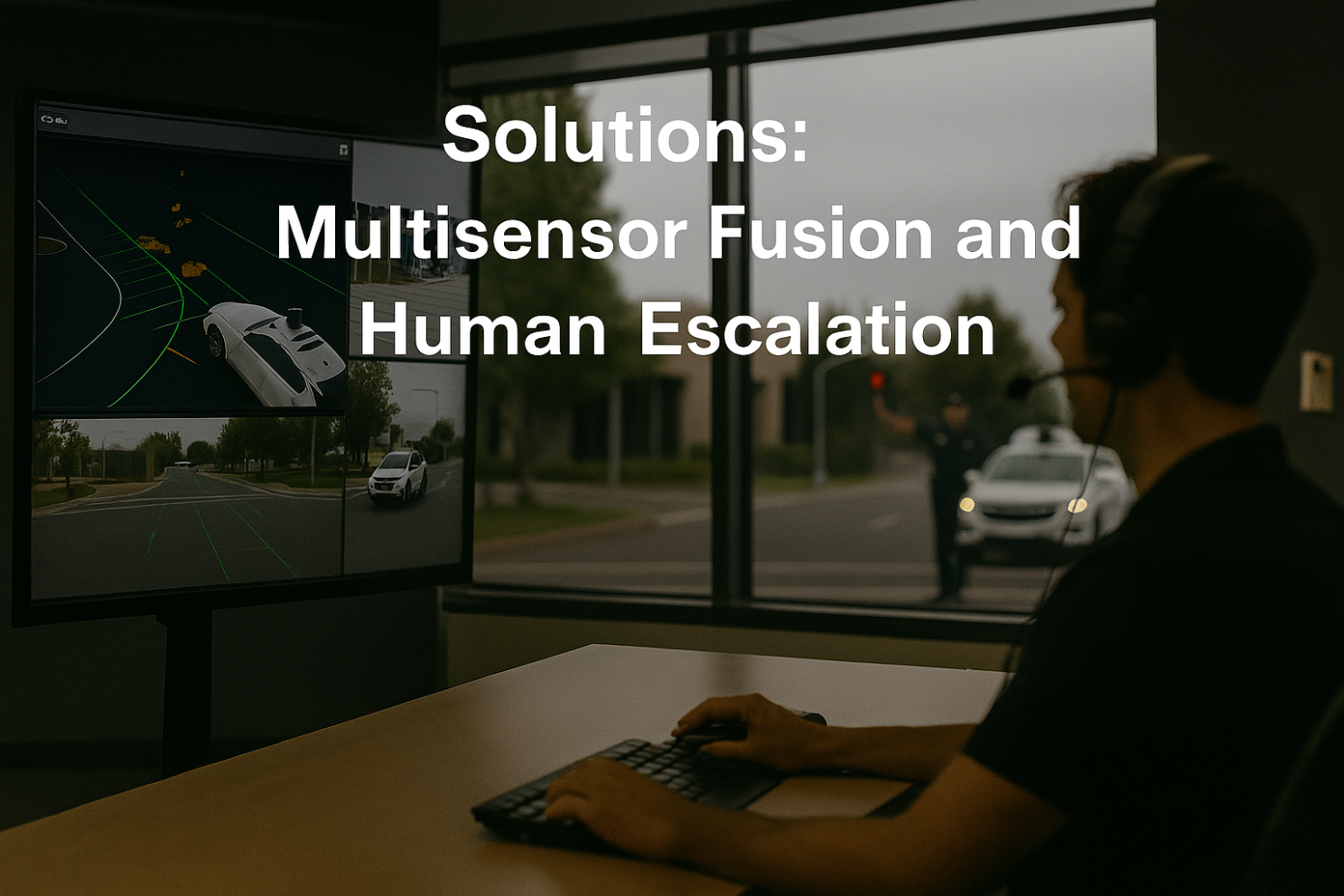
These approaches shift autonomy away from brittle automation toward probabilistic decision‑making under uncertainty.
4. Comparative Review of Major Industry Actors
4.1 Waymo (Alphabet)
Waymo represents the most mature example of authority‑aware autonomy in production. Operating Level 4 robotaxis within narrowly defined ODDs, Waymo vehicles explicitly detect traffic officers, defer action until intent is understood, and escalate ambiguous cases to remote specialists. This conservative autonomy model prioritizes safety and legal compliance but still exhibits hesitation in complex or chaotic scenes.
Assessment: Operationally viable within geofenced environments; autonomy remains tightly coupled to human supervision infrastructure.
4.2 Tesla Full Self‑Driving (Supervised)
Tesla’s Full Self‑Driving (FSD) system has demonstrated rapid improvement in recognizing police gestures, particularly in recent software releases. Tesla’s vision‑only, data‑driven approach allows fast generalization across diverse scenarios. However, FSD remains a Level 2 system, explicitly requiring continuous driver supervision.
Regulatory scrutiny highlights that while progress is evident, autonomous compliance with human authority remains inconsistent without human fallback.
Assessment: Fast learning curve, but reliability is insufficient for unsupervised autonomy.
4.3 Cruise (General Motors)
Cruise’s challenges with police‑directed traffic—including immobilized vehicles and misinterpreted authority—illustrate the risks of deploying automation without robust escalation pathways. These failures contributed to erosion of regulatory and public trust, culminating in the suspension and eventual shutdown of Cruise’s robotaxi operations.
Assessment: A cautionary example emphasizing the necessity of authority modeling and operational humility.
4.4 Mercedes‑Benz DRIVE PILOT
Mercedes takes a fundamentally different approach. DRIVE PILOT, a Level 3 system, explicitly excludes environments involving police direction, construction zones, or irregular traffic control. Upon detecting such conditions, control is handed back to the human driver.
This strategy avoids incorrect autonomous decisions but does not attempt to solve the underlying challenge.
Assessment: Legally robust and safety‑oriented, yet strategically non‑scaling.
4.5 Zoox (Amazon)
Zoox occupies a distinct position within the autonomy landscape. Unlike retrofitted consumer vehicles or modified production cars, Zoox is developing a purpose‑built, bidirectional autonomous vehicle optimized for dense urban robotaxi operation. Zoox’s design philosophy emphasizes holistic system integration: perception, planning, vehicle architecture, and operations are co‑designed.
In the context of police‑directed traffic, Zoox benefits from:
- High sensor redundancy, including lidar‑heavy perception well suited to human pose tracking.
- Urban‑first ODDs, where manual traffic control is common and explicitly anticipated.
- Strong reliance on remote operations, aligning closely with Waymo’s escalation‑based safety model.
However, Zoox remains in earlier stages of public deployment relative to Waymo, and large‑scale data on its real‑world handling of police‑directed traffic is limited.
Assessment: Architecturally well positioned to manage authority‑driven scenarios, contingent on operational maturity rather than novel perception breakthroughs.
5. Timeline to Meaningful Resolution
Based on current technical trajectories, operational models, and regulatory posture:
- Geofenced robotaxis (Waymo, Zoox‑class systems): Police‑directed traffic will likely be operationally resolved—with routine human escalation—by 2027–2028 in select cities.
- Consumer autonomy (Tesla‑style systems): Reliable, unsupervised handling is unlikely before 2028–2030, and may remain legally constrained.
- Universal, human‑independent autonomy: No credible timeline exists; persistent escalation channels appear inevitable.
6. Conclusion
Police‑directed traffic is not an anomalous edge case but a structural boundary condition for autonomous driving. It exposes the limits of infrastructure‑centric automation and forces systems to reason about authority, intent, and legality under uncertainty.
The comparative analysis suggests that success is less dependent on any single perception model and more on system‑level humility: the ability to defer, escalate, and incorporate humans appropriately. Purpose‑built robotaxis such as Waymo and Zoox demonstrate that autonomy can function safely within this paradigm, but only by accepting that some aspects of social traffic control resist full automation.
Ultimately, the maturation of autonomous driving may be marked not by the removal of humans from the loop, but by the precision with which they are integrated into it.