
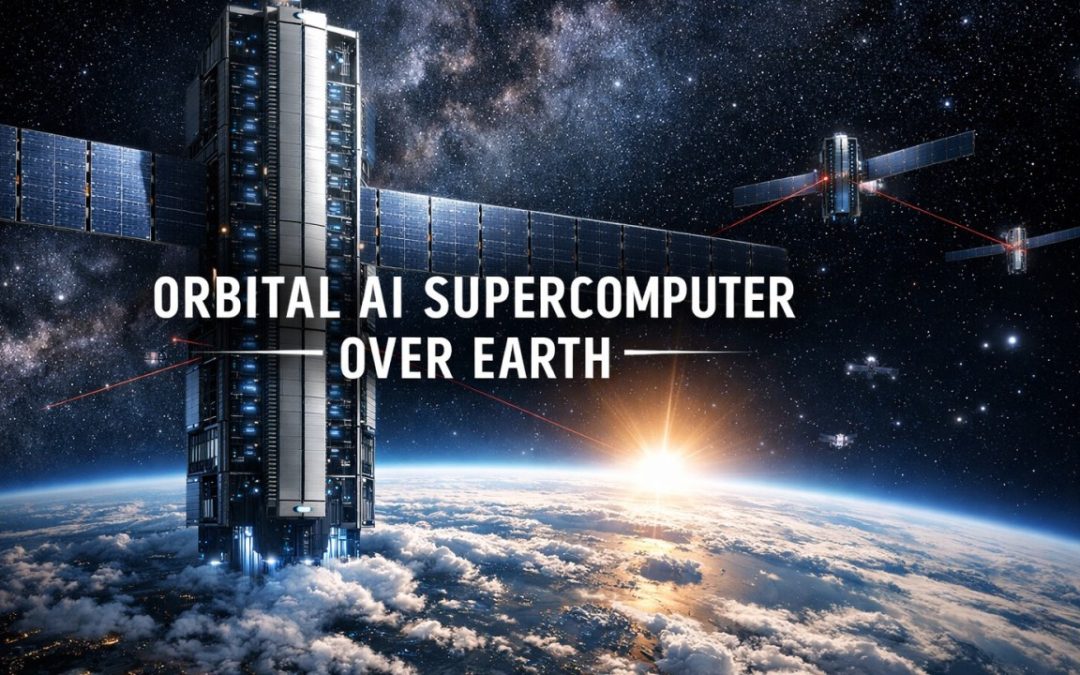
Space X’s plan to build AI compute in space marks one of the most radical shifts in the history of computing infrastructure. Instead of expanding Earth‑based data centers—which are hitting limits in power, cooling, and land—Space X is pushing compute into orbit through a new class of spacecraft: AI‑optimized data‑center satellites.These satellites, beginning with SpaceX’s AI1 platform, are designed to run large‑scale AI workloads using solar power, vacuum cooling, and laser‑linked networking. The long‑term ambition is staggering: tens of thousands—and eventually up to a million—orbital compute nodes forming a planetary‑scale AI supercomputer. But the story doesn’t end there. The next frontier is quantum computing, and its arrival could reshape both Earth‑based and orbital compute ecosystems.
1. Why Space X Is Building Compute in Space
Earth‑based data centers are running into hard physical limits: Power grids are strained
Cooling requires massive water and energy
Land and permitting are increasingly scarce
AI demand is growing faster than infrastructure can be built
Orbital compute solves these constraints: Near‑constant solar power
Radiative cooling directly into spaceZero land footprint
Global coverage via laser‑linked constellations
Space becomes a clean, scalable, and effectively limitless platform for AI growth.
2. Orbital Compute vs. Earth Data Centers
Here’s the updated, integrated comparison.
PowerOrbit: Continuous, unfiltered solar energy; no grid limits
Earth: Dependent on local grids; rising energy costs; regulatory caps
Cooling
Orbit: Radiative cooling; no water; no HVAC
Earth: Water‑intensive; climate‑dependent; expensive
Latency
Orbit: Higher latency; best for batch AI training
Earth: Ultra‑low latency; best for real‑time inference
Maintenance
Orbit: Hard to repair; radiation exposure
Earth: Easy hardware swaps; predictable lifecycle
Cost
Orbit: High today; falling with Starship
Earth: Mature, optimized, cheaper per watt
Scalability
Orbit: Massive long‑term potential
Earth: Limited by land, water, and power
Bottom line:
Earth handles low‑latency, high‑reliability workloads.
Orbit handles power‑hungry, cooling‑intensive AI training at planetary scale.
3. What Happens When Quantum Computers Mature
Quantum computing is the wildcard that could reshape both ecosystems.
Scenario A — Quantum Compute on Earth
This is the most realistic near‑term path.
Quantum systems require:
Cryogenic cooling
Vibration isolation
Shielding from radiation
Ultra‑stable power
Earth is far better suited for this environment.
Impact on orbital compute:
Orbital AI satellites continue handling classical AI workloads
Earth‑based quantum centers handle optimization, simulation, and cryptography
Hybrid systems emerge: quantum pre‑processing + orbital AI training
Orbital compute remains relevant because quantum does not replace classical AI—it accelerates specific tasks.
Scenario B — Quantum Compute in Orbit
This is possible, but extremely difficult.
Challenges: Quantum hardware is fragile
Radiation in orbit destroys qubits
Cryogenic systems require heavy shielding
Maintenance is nearly impossibleIf solved, orbital quantum compute would be revolutionary:
Unlimited solar power
Perfect vacuum for some qubit types
Global quantum networking via laser links
But this is far beyond current engineering capability.
4. Realistic Timeline
Here’s the grounded, non‑hyped timeline based on current industry progress.
2026–2030: Orbital Compute Scaling
AI1 satellites begin deployment
Starship V3 launches large batches
Orbital compute becomes a commercial service
Earth data centers continue to expand but hit regional limits
2030–2035: Hybrid AI InfrastructureOrbital compute handles large‑scale training
Earth handles inference and low‑latency workloads
Early quantum accelerators integrate into classical data centers
2035–2045: Practical Quantum Computing
Fault‑tolerant quantum systems emerge
Quantum accelerates optimization, chemistry, and simulation
AI training still relies on classical compute (orbital + terrestrial)
Quantum + orbital compute pipelines become standard
2045+: Quantum in Orbit (Speculative)Only if radiation‑hardened, cryogenic‑stable quantum systems are inventedWould require breakthroughs in materials, shielding, and qubit stability could create a planetary quantum‑AI hybrid network
Realistic conclusion:
Quantum computing enhances orbital compute—it does not replace it.
5. The Future: A Three‑Layer Compute Stack
The world is heading toward a layered compute architecture:
Earth (Quantum + Classical)Real‑time inference
Quantum acceleration
Maintenance‑heavy workloads
Orbit (Massive Classical AI Training)
High‑power, high‑cooling workloads
Planet‑scale model training
Edge (Devices + Local AI)Phones, cars, robots
On‑device inference
This is the architecture Space X is betting on—and quantum computing fits into it rather than replacing it.