
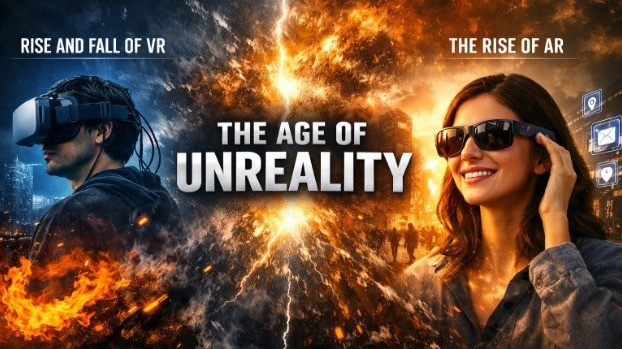
Reality Used to Be Simple
For most of human history, you opened your eyes and the world simply was.
Then engineers asked a radical question: What if reality could be edited?
That question birthed XR — Extended Reality — the umbrella term for technologies that change what you see and experience.
XR includes two siblings:
Virtual Reality (VR): replaces your surroundings with a digital world
Augmented Reality (AR): overlays digital information onto the real world through glasses or devices.
Together, they promised to reinvent human experience.
The First Break in Reality: VR Arrives
In the early 2010s, VR hit like a lightning strike.
Oculus proved you could trick the brain into believing it was somewhere else entirely.
Facebook’s $2B acquisition made VR feel inevitable.
Suddenly: Gamers imagined infinite worlds
- Architects walked through buildings before they existed
- Educators taught inside simulations
- Corporations pitched the Metaverse
- VR felt like destiny.
But destiny is heavy — and VR struggled to carry it.
The Challenges: When Reality Fought Back
- VR was magical… but impractical.
- Hardware was bulky, sweaty, isolating
- Content was limited outside gaming
- The Metaverse became a corporate mirage
AR was even harder — requiring optics that bent light in impossible ways
The industry didn’t collapse. It simply overpromised and underdelivered.
The Plot Twist: AI Rewrites the XR Story
Then came the revolution no one predicted: AI.
Not the old AI — the new one.
Conversational, multimodal, always‑on intelligence that could live inside a pair of glasses.
Suddenly XR didn’t need to be immersive.
It needed to be useful.
Smart glasses exploded:
- Ray‑Ban Meta AI sold millions
- XREAL, RayNeo, VITURE, Xiaomi accelerated innovation
Glasses became assistants, translators, cameras, memory engines
- XR shifted from escapism → augmentation.
- From fantasy → utility.
- From headsets → wearables.
Where We Are Now: A Split Industry Still Growing
VR Today: VR is shrinking — fewer shipments, fewer launches.
But it thrives in:
- Gaming
- Training
- Medical and military simulations
VR didn’t die. It specialized.
AR Today: AR is exploding.
Smart glasses are becoming the next major consumer device category.
AR is now:
- A daily assistant
- A productivity layer
- A new interface for digital life
XR Overall:
Even with VR’s decline, XR is growing — because AR is pulling the industry forward.
Where We’re Headed: The Hybrid Reality Era
Three forces will define the next decade:
- AI as the Operating System of Reality. Your glasses will understand your environment, tasks, and preferences.
- Spatial Computing. Screens dissolve. Interfaces float. The world becomes your workspace.
- Hybrid Reality:
- VR for immersion.
- AR for everyday life.
- AI as the connective tissue.
- The future won’t be virtual.
- It will be augmented — seamlessly, invisibly, constantly.
The Final Word:
- XR didn’t fail.
- It evolved.
- The dream of escaping reality was too fragile.
But the dream of enhancing reality?
That one is unstoppable.
We’re entering an era where reality becomes a canvas — and XR is the brush.