
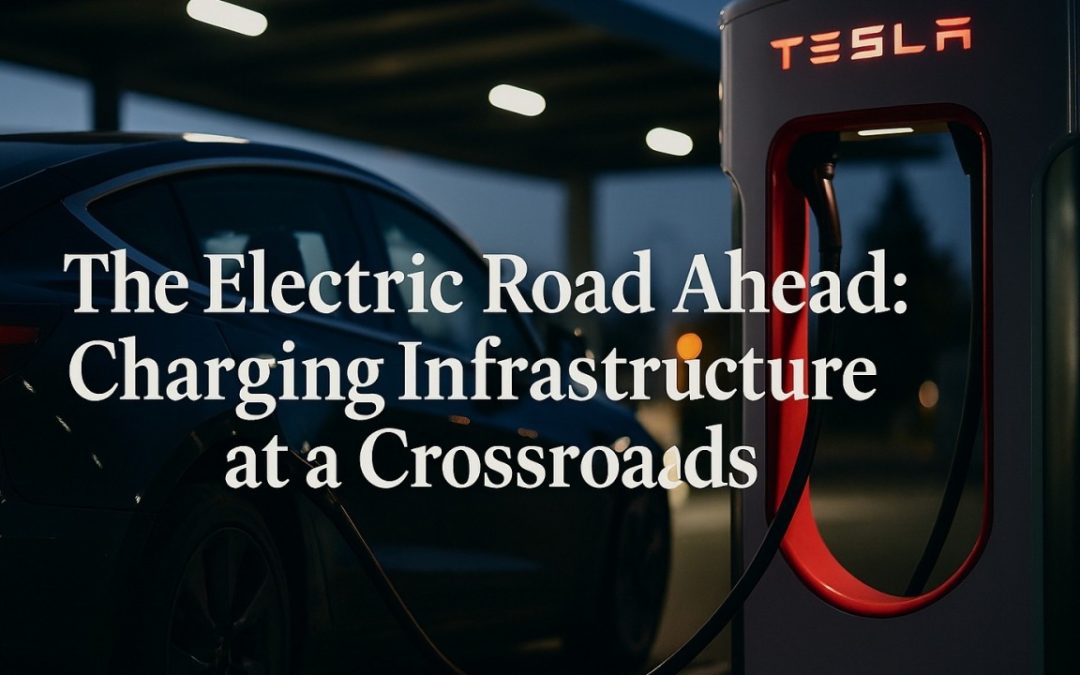
On a highway outside Cleveland, a driver of a new electric SUV pulls off to recharge. She faces a decision familiar to millions of early EV adopters: which network to trust, which plug will fit, and whether the station will actually work. What should feel like a routine stop—akin to filling a gas tank—remains, today, a small act of logistical risk.
Yet beneath this friction lies one of the most profound industrial transformations in a century. The electric vehicle revolution is no longer a question of if, but how fast—and how smoothly—the charging infrastructure can evolve to meet it.
A Surge in EVs, and an Urgent Infrastructure Gap
Automakers are pushing aggressively into electrification. Driven by emissions targets and consumer demand, nearly every major manufacturer—from Ford to Volkswagen to Hyundai—plans to electrify a significant share of its lineup by 2030.
The scale of the transition is staggering. U.S. EV stock is projected to reach roughly 26 to 30 million vehicles by 2030, up from just a few million in the early 2020s.
This growth is enabled, in part, by the falling cost of renewable energy, which makes charging cheaper and more sustainable. Solar and wind power—now among the lowest-cost sources of electricity—are aligning perfectly with EV charging demand.
But the numbers expose the problem: tens of millions of vehicles will require hundreds of thousands of fast chargers.
The cars are arriving faster than the infrastructure.

Tesla’s Network Becomes America’s Backbone
In this gap, Tesla has emerged as an unlikely standard-setter.
For years, Tesla’s Supercharger network stood apart—reliable, fast, and exclusive. Now, it is becoming universal. The company’s North American Charging Standard (NACS) has been adopted by nearly every major automaker, including Ford and General Motors, with new models set to include the connector beginning in 2025.
Adapters are already bridging the transition, allowing non-Tesla EVs to tap into thousands of Superchargers.
The implications are profound:
•Tesla’s network may become the default “fueling” system for North America
•Charging interoperability—once fragmented—begins to converge
•The industry moves toward a single, consumer-friendly standard
Like USB for electronics, NACS is transforming charging from a compatibility puzzle into an expectation of simplicity.

The Fragmentation Problem: Finding a Charger
Even with progress, today’s EV experience remains disjointed.
Drivers often rely on multiple apps to locate stations. Navigation systems in many vehicles still prioritize proprietary or partner networks, leaving out competing chargers. A Ford driver, for example, may not easily see Electrify America or Tesla stations unless software is updated or a third-party app is used.
This fragmentation creates a new kind of “range anxiety”—not about battery life, but about information.
The U.S. Department of Energy already advises drivers to pre-plan routes and download multiple charging network apps, underscoring the complexity.
True mass adoption will require a unified ecosystem where:
•All chargers appear in all navigation systems
•Payment is seamless
•Reliability is standardized

From Gas Stations to Charging Hubs
The future of EV charging is not just technical—it is experiential.
Traditional gas stations are being reimagined as high-speed charging hubs, often integrated with retail. The concept of the “EV mart” is already emerging: convenience stores, restaurants, and shopping areas designed for the 20–30 minute dwell time of fast charging.
This trend is driven by simple economics:
•Charging stops are longer than fueling stops
•Drivers want amenities—food, Wi-Fi, restrooms
•Retailers benefit from increased dwell time and spending
Studies show charging stations near retail locations see dramatically higher usage, with grocery-adjacent chargers attracting up to five times more sessions.
Companies like EVectriFi and other emerging players are building networks specifically designed around this “destination charging” model.
In time, the charging station may look less like a pump and more like a rest stop for the digital era.

The Technology Leap: Faster, Smarter, Portable
Level 3 vs. Level 4 Charging
Today’s fast charging—Level 3 (DC fast charging)—can add hundreds of miles of range in about 30 minutes.
But the next frontier is Level 4 charging, capable of delivering up to 1 megawatt of power and potentially charging vehicles in 15–20 minutes.
This leap matters for long-distance travel, where time parity with gasoline refueling is essential.
Battery Innovation: The Silver Race
Charging speed and infrastructure are only half the story. Battery technology is evolving just as quickly.
Samsung’s emerging solid-state “silver batteries” promise:
•Up to 600 miles of range
•Charging in as little as 9 minutes
•Lifespans of up to 20 years
But these innovations introduce new challenges. These batteries rely heavily on silver—potentially up to 1 kilogram per vehicle—raising concerns about supply constraints.
At the same time, the rise of AI data centers—also energy-intensive and resource-demanding—competes for the same grid capacity and raw materials.
The EV revolution is now entangled with a broader technological race.

A fully electric future must account for edge cases:
•Blackouts
•Rural gaps
•Infrastructure failures
Enter mobile charging stations—battery-equipped vans or buses that can deliver on-demand electricity.
These systems may become the EV equivalent of roadside assistance. They also hint at a future where portable “suitcase batteries” could provide emergency range, replacing the psychological comfort once provided by a gas can.

The Privacy Question
As vehicles become more connected—and increasingly autonomous—charging infrastructure intertwines with data.
Automakers are integrating sensors, cameras, and tracking systems to optimize charging routes and enable self-driving features. But this has sparked growing resistance among drivers wary of surveillance.
The tradeoff is clear:
•More data enables safer, smarter EV ecosystems
•Less privacy may be required to achieve it
This tension will define public acceptance as much as infrastructure itself.
An Awkward Transition
The American auto market is in a liminal moment. The internal combustion sedan—the bedrock of 20th-century mobility—is quietly fading. Cadillac’s CT4, one of the last compact sedans, is ending production, while the CT5 lingers largely for enthusiast appeal.
This is not merely a product shift—it is a cultural one.
The United States is living through a transition as profound as the move from horse and buggy to gasoline cars. But unlike that earlier shift, this one is constrained by infrastructure, software, and energy systems all evolving simultaneously.
A Timeline to Maturity
2025–2027
•Widespread NACS adoption across automakers
•Rapid buildout of fast-charging corridors
•First solid-state batteries in premium EVs
2027–2030
•Level 4 charging begins scaling
•EV marts and retail hubs expand nationwide
•Mobile charging networks become common
2030 and beyond
•Full interoperability across networks
•Charging times rival gasoline refueling
•EV adoption reaches tens of millions of vehicles
The Road to Cohesion
The EV charging ecosystem is not just about plugs and power—it is about coordination.
Automakers, utilities, retailers, and technology companies must align around:
•Standards (NACS)
•Data sharing
•Grid investment
•User experience
Without this cohesion, the EV remains a local vehicle, confined by uncertainty. With it, the electric car becomes what it was always meant to be: a true replacement for the gasoline automobile.
For now, the driver in Cleveland waits, watching the progress bar inch upward.
In a decade, she may not notice the stop at all.