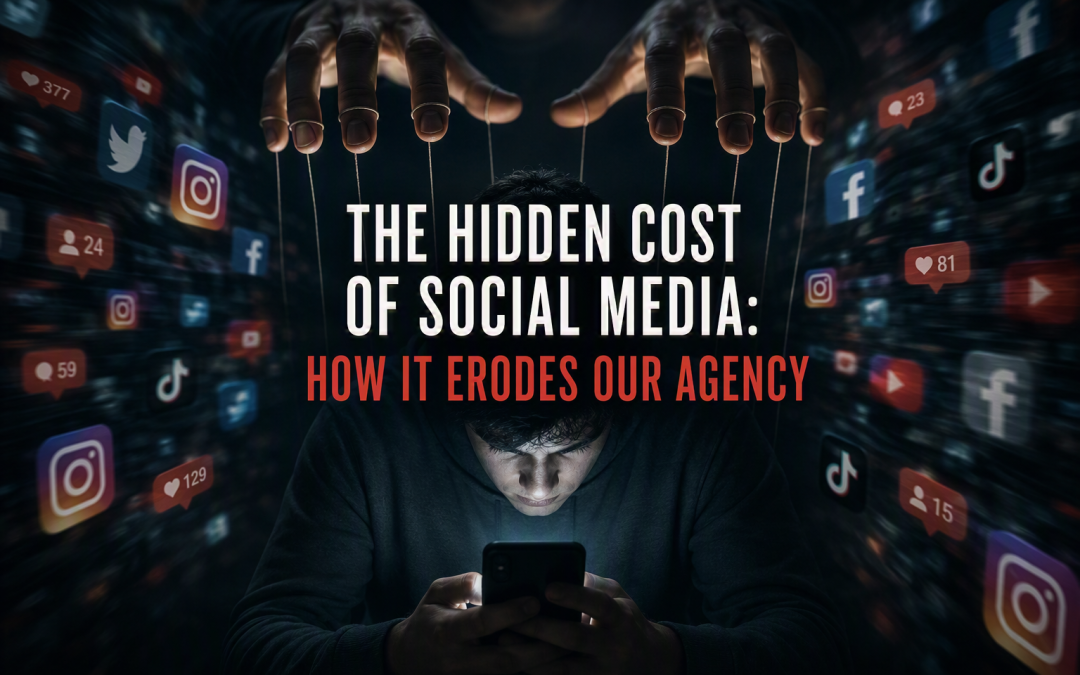
We often discuss social media in terms of productivity, mental health, misinformation, or politics. But there is a deeper issue that receives far less attention: the gradual erosion of human agency.
Agency is our capacity to make choices, direct our actions, shape our relationships, and influence our own lives. It is what makes us autonomous individuals rather than passive recipients of external forces.
While social media platforms promise empowerment, connection, and self-expression, their underlying business models frequently depend on capturing attention, influencing behavior, and keeping users engaged for as long as possible. The result is a subtle but profound reduction in several forms of human agency.
1. Personal Agency: From Choosing to Reacting
Personal agency is our ability to consciously direct our lives and make independent decisions.
Social media reduces personal agency by creating environments designed around immediate responses rather than deliberate choices. Notifications, algorithmic recommendations, likes, comments, and endless feeds constantly pull users toward platform-generated priorities.
Instead of asking:
“What do I want to do?”
we increasingly ask:
“What happened online while I was away?”
Our attention becomes externally directed rather than internally guided.
Over time, many decisions are no longer entirely self-generated. What we view, purchase, discuss, and even aspire to become may be heavily influenced by algorithms optimized for engagement rather than personal growth.
2. Cognitive Agency: Losing Control of Attention
Cognitive agency is the ability to direct our thinking, focus, and mental resources.
Attention is the foundation of thought. Yet social media platforms compete aggressively for it.
Features such as:
- Infinite scrolling
- Short-form video feeds
- Push notifications
- Engagement-driven content
fragment attention and encourage rapid context switching.
The result is a reduction in our ability to:
- Focus deeply
- Reflect critically
- Think independently
- Sustain concentration
When algorithms determine what commands our attention, our minds become reactive rather than intentional.
The battle for attention is ultimately a battle for cognitive agency.
3. Epistemic Agency: Letting Algorithms Shape Belief
Epistemic agency is our ability to form beliefs through independent evaluation of evidence.
Historically, individuals actively sought information from multiple sources. Today, information increasingly finds us through algorithmic curation.
The problem is not simply misinformation.
The larger issue is that users rarely see information selected according to truth, balance, or educational value. Instead, content is selected according to engagement potential.
As a result:
- Confirmation bias is reinforced.
- Echo chambers become stronger.
- Nuance is replaced by emotional certainty.
- Complex issues are reduced to simplistic narratives.
When algorithms increasingly determine what information we encounter, our ability to independently shape our understanding of reality declines.
4. Social Agency: Relationships Become Platform-Dependent
Social agency refers to our ability to influence and participate in social life.
At first glance, social media appears to enhance social agency. We can reach thousands of people instantly.
However, most social interactions now occur within systems governed by platform rules, ranking algorithms, and engagement metrics.
Visibility is no longer determined primarily by the quality of relationships but by platform optimization.
Many people now experience social life through:
- Followers
- Likes
- Shares
- Engagement statistics
As a result, social influence becomes increasingly dependent on platform design rather than authentic human connection.
Our social agency becomes mediated by technology companies.
5. Relational Agency: Dating by Algorithm
Relational agency is our ability to build meaningful interpersonal relationships.
Dating platforms have transformed how people meet.
While they dramatically increase access to potential partners, they also reshape how people evaluate one another.
Individuals become profiles.
Relationships become selections.
Human beings become entries in a searchable database.
This creates several challenges:
- Choice overload
- Reduced commitment
- Increased disposability
- Constant comparison
- Optimizing for attractiveness over compatibility
Users often feel they are making more choices than ever. Yet the pool of potential interactions is heavily filtered and ranked before they even see it.
The algorithm increasingly influences who becomes romantically visible and who does not.
6. Moral Agency: Ethics Under Social Pressure
Moral agency is the ability to make ethical judgments and act according to moral principles.
Social media environments reward visibility, approval, and group conformity.
The pressure to gain social validation can encourage:
- Virtue signaling
- Outrage amplification
- Mob behavior
- Public shaming
- Tribal thinking
People may make moral decisions not because they genuinely believe them to be right but because they fear social consequences.
The question shifts from:
“What is the right thing to do?”
to:
“How will this be perceived online?”
This weakens independent moral reasoning and strengthens conformity to digital crowds.
7. Emotional Agency: Outsourcing Self-Worth
Emotional agency is our ability to regulate our emotional lives.
Social media platforms frequently create cycles of:
- Validation seeking
- Social comparison
- Fear of missing out
- Anxiety
- Envy
- Rejection sensitivity
Many users increasingly depend on external feedback to determine self-worth.
A post performs well and confidence rises.
A post performs poorly and confidence falls.
Dating apps intensify this dynamic through constant acceptance and rejection signals.
When emotional states become heavily dependent on platform feedback loops, emotional agency weakens.
8. Political Agency: Participation or Manipulation?
Political agency is the ability to influence public affairs.
Social media has undeniably democratized access to political communication.
Yet it has also created unprecedented opportunities for:
- Microtargeting
- Behavioral influence
- Polarization
- Manipulation
- Information warfare
Citizens are no longer simply participants in political discourse; they are also targets of sophisticated systems designed to influence beliefs and behavior.
A politically engaged population is valuable.
A politically manipulated population is dangerous.
The distinction matters.
9. Creative Agency: Creation Becomes Optimization
Creative agency is the ability to generate original ideas and expressions.
Social platforms often reward predictability over originality.
Creators learn rapidly what performs well:
- Certain formats
- Certain topics
- Certain visual styles
- Certain emotional triggers
Over time, creativity shifts toward optimization.
Instead of asking:
“What do I want to create?”
many creators begin asking:
“What will perform best?”
The algorithm becomes an invisible editor influencing creative decisions before they are made.
10. Collective Agency: Communities Fragmented by Algorithms
Collective agency is the ability of groups to pursue shared goals.
Although social media can mobilize communities quickly, it can also weaken long-term collective action.
Algorithms favor:
- Novelty
- Emotion
- Conflict
- Immediate engagement
Effective collective action, however, requires:
- Trust
- Patience
- Cooperation
- Long-term commitment
As attention continuously shifts to the next trend, many movements struggle to sustain momentum.
Communities become highly reactive but less durable.
The Bigger Issue: Algorithmic Mediation of Human Agency
The greatest challenge posed by social media is not that it removes agency entirely.
Rather, it restructures agency.
We still make choices.
But increasingly, those choices occur within environments designed by algorithms that:
- Determine what we see.
- Predict what we want.
- Influence what we believe.
- Shape whom we meet.
- Guide what captures our attention.
In other words, we increasingly exercise agency inside systems engineered to influence the exercise of agency itself.
Final Thought
The defining question of the digital age may not be whether social media is good or bad.
The real question is:
How much of our thinking, believing, choosing, relating, creating, and acting is genuinely our own—and how much has been quietly delegated to algorithms?
As leaders, professionals, and citizens, protecting human agency may become one of the most important responsibilities of the 21st century. Because when agency declines, autonomy declines. And when autonomy declines, freedom eventually follows.