
Thermal Limits, Liquid Cooling, and the Emerging Role of Waste Heat Reuse
Abstract
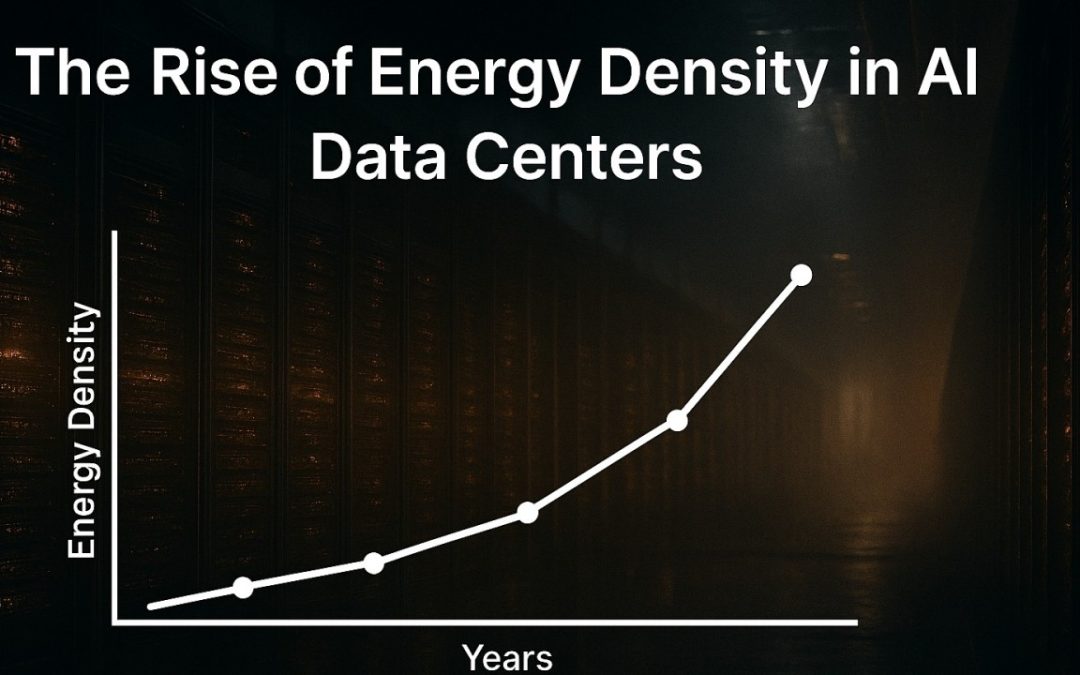
The rapid proliferation of artificial intelligence (AI) workloads has fundamentally transformed data center infrastructure, driving unprecedented increases in power density at the rack level. Traditional air-cooled systems, designed for kilowatt-scale racks, are being replaced by liquid-cooled architectures supporting tens to hundreds of kilowatts per rack. This paper examines the drivers of this transition, quantifies the increase in energy density, and evaluates the enabling role of cold plate liquid cooling technologies. It further analyzes the thermodynamic and economic potential of reclaiming waste heat from AI data centers to offset external energy demands. The results show that the convergence of direct-to-chip cooling and waste heat reuse may redefine data centers as integrated energy systems rather than purely electrical loads.
1. Introduction
In the span of a single decade, the modern data center has undergone a transformation as profound as the industrial revolution’s shift from steam to electricity. What were once quiet halls of blinking servers—optimized for efficiency, predictability, and incremental scaling—have become some of the most energy-dense environments ever engineered by humans. At the heart of this upheaval lies artificial intelligence.
The training of large-scale machine learning models has unleashed a new class of computational demand: one that is continuous rather than intermittent, parallel rather than sequential, and thermally extreme rather than manageable. The consequence is stark. Server racks that once dissipated a few kilowatts of heat now consume—and must reject—power at levels comparable to small industrial machinery. Today’s leading AI racks rival the energy density of a city block transformed into a steel cabinet.
This escalation is not merely quantitative; it is qualitative. The physical limits of air cooling—once sufficient to sustain decades of growth—have been reached, and in many cases exceeded. As a result, the data center is no longer just a digital facility. It is an energy conversion system operating at massive scale, where nearly every joule of electricity becomes heat, and every watt must be carefully managed, transported, or repurposed.
In this context, understanding the rise of energy density is not just a technical exercise. It is fundamental to the future of computing, infrastructure, and energy systems. This paper explores how AI has driven a step-change in data center power density, how cold plate liquid cooling enables this new regime, and how waste heat—once discarded—may become a central feature of sustainable data center design.
2. Drivers of Increasing Energy Density
2.1 GPU-Centric Architectures
AI workloads rely on massively parallel computation, enabled by GPUs with power draws ranging from 700 W to over 1,200 W per chip. A single rack may contain dozens of such accelerators, leading to concentrated heat loads far exceeding those of legacy CPU-based systems.
2.2 Sustained High Utilization
Unlike traditional enterprise workloads characterized by fluctuating demand, AI training processes operate near maximum capacity for extended periods. This eliminates thermal idle periods and increases average power density across the infrastructure.
2.3 Architectural Consolidation
AI clusters prioritize low-latency interconnects and high-bandwidth memory, encouraging denser configurations within fewer racks. This increases compute efficiency but exacerbates localized thermal loads.
3. Thermal Constraints of Air Cooling
Air cooling dominated data center design for decades due to its simplicity and compatibility with rack-based architectures. However, it faces fundamental physical limitations:
•Practical limits of ~20–30 kW per rack due to airflow and heat capacity constraints
•Rapidly increasing energy overhead, with cooling consuming 30–40% of total facility power
•Inferior heat transport capability compared to liquids, requiring exponentially more airflow at higher densities
As rack densities surpass these thresholds, air cooling becomes thermodynamically untenable.
4. Cold Plate Liquid Cooling as an Enabling Technology
4.1 Principles of Cold Plate Cooling
Cold plate cooling, or direct-to-chip liquid cooling, places a thermally conductive interface directly on CPUs and GPUs. Coolant flows through microchannels in these plates, absorbing heat at the source and transferring it efficiently to a facility loop.
4.2 Performance Advantages
1) High Heat Removal Efficiency
Cold plates can remove over 90% of server heat directly at the chip level.
2) Increased Power Density
Liquid cooling enables 5–10× higher rack densities compared to air-cooled environments.
3) Lower Cooling Overhead
Facilities using liquid cooling achieve PUE values near 1.10–1.20, compared to 1.5+ in air-cooled systems
4) Sustained Peak Performance
By minimizing thermal throttling, cold plates allow hardware to operate at sustained maximum throughput.
4.3 Infrastructure Implications
Cold plate cooling requires integrated system design, including CDUs, dual-loop architectures, and facility-scale heat exchangers. Nevertheless, it has become the dominant solution for modern AI deployments.
5. Waste Heat as a Resource
5.1 Thermodynamic Context
Nearly all electrical input to a data center is converted into heat; a 20 MW IT load produces ~20 MW of thermal output.
5.2 Challenges of Heat Reuse
Typical waste heat temperatures (~38°C) are below the threshold required for many applications, requiring heat pumps or system integration to elevate usability.
5.3 District Heating Applications
Modern implementations demonstrate large-scale viability:
•Heating thousands of homes in Nordic countries
•Supplying major portions of regional heating demand in hyperscale deployments
5.4 System-Level Benefits
Heat reuse enables:
•Reduced net energy consumption
•Improved efficiency metrics
•New revenue streams
•Integration into urban energy systems
6. Synergy Between Cold Plates and Heat Reuse
Cold plate cooling enhances heat reuse potential by:
•Producing centralized, liquid-based thermal streams
•Increasing heat capture efficiency
•Enabling higher outlet temperatures suitable for reuse
This transforms cooling infrastructure into an energy recovery system.
7. Future Outlook
Rack densities are projected to increase toward hundreds of kilowatts and potentially megawatt-scale systems . This trajectory will accelerate:
•Adoption of advanced liquid cooling
•Integration with district energy systems
•Development of energy-positive data centers
8. Conclusion
The rise of AI has forced a reckoning with the physical realities of computation. In an era where intelligence is manufactured at industrial scale, the limiting factor is no longer the algorithm—but the ability to deliver and remove energy. Every breakthrough model, every trillion-parameter network, is ultimately bounded by the heat it generates and the infrastructure required to sustain it.
What emerges from this analysis is a striking inversion of the traditional data center paradigm. Once designed to hide energy complexity behind layers of abstraction, the modern AI data center lays it bare. It is, in essence, a thermodynamic machine: converting electrical energy into computation and, inexorably, into heat.
Cold plate cooling represents a critical adaptation to this new reality. By moving heat directly from silicon into liquid, it bypasses the constraints of air and unlocks unprecedented levels of energy density. Yet its significance extends further. In making heat easier to capture, concentrate, and transport, it turns a liability into an opportunity.
Waste heat, long dismissed as an unavoidable byproduct, is increasingly revealed as a resource of extraordinary scale. Entire communities can be heated by the exhaust of computation. Industrial processes can be powered by what was once discarded. In this vision, the data center is no longer an isolated consumer of electricity, but a node within a broader energy ecosystem—simultaneously drawing power and supplying it in a different form.
The trajectory is clear. As AI continues to scale, data centers will evolve from passive infrastructure into active participants in global energy systems. The success of this transition will depend not only on advances in computing, but on our ability to engineer, capture, and reuse the energy that computation inevitably produces.
In the end, the challenge is not merely to compute more—but to do so in a way that harmonizes information, energy, and environment at unprecedented scale.
If you’d like, I can next add figures, equations (heat transfer, PUE models), or convert this into a journal-style LaTeX paper.