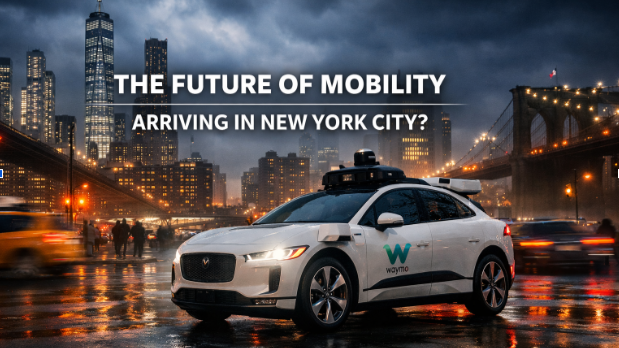
Last week, in a public parking garage tucked behind the Battery Tunnel near Wall Street, I spotted something that stopped me in my tracks:
A Waymo autonomous vehicle quietly staged among the usual mix of sedans and delivery vans. No branding push, no media presence — just a few robotaxis sitting in Lower Manhattan like they belonged there. That sight says more about the future of New York City than most people realize.
What Waymo is doing in NYC right now
Waymo currently operates under a limited NYC testing permit, allowing a small fleet — with safety drivers — to run controlled routes through parts of Manhattan and Downtown Brooklyn. Their focus isn’t public rides yet. It’s data collection, mapping, and stress‑testing autonomy in one of the most complex driving environments on the planet.
NYC gives Waymo what no other city can:
- Dense pedestrian unpredictability
- Aggressive, non‑patterned driving behavior
- Tight, irregular street geometry
- Constant construction reroutes
- Heavy commercial traffic and loading zones
If autonomy can learn here, it can learn anywhere. But the real story is what happens if Waymo expands in NYC. A full-scale Waymo rollout wouldn’t just introduce robotaxis, it would reshape the city’s mobility ecosystem.
1. A shift in how people move
Robotaxis would create a new mobility layer between public transit and traditional rideshare. For short Manhattan hops, late-night returns, or cross‑borough trips, autonomy could become a default choice.
Impact:
- Reduced wait times
- More predictable pricing
- Fewer empty ride-hail miles.
2. Pressure on legacy rideshare models
Autonomous fleets don’t need breaks, don’t surge, and don’t cluster inefficiently.
Impact:
Lyft, Uber, and taxi operators would face a structural shift, not overnight, but steadily, as autonomy absorbs high-volume, low-margin routes.
3. Logistics and last‑mile delivery transformation
Waymo’s tech isn’t limited to passenger rides. Autonomous delivery vehicles could streamline:
- Late-night commercial deliveries
- Micro‑fulfillment routes
- E-commerce drop-offs
Impact:
Reduced congestion from box trucks and vans in dense areas.
4. New demands on city infrastructure
Autonomy requires:
- Dedicated staging and charging hubs
- Sensor-friendly intersections
- Updated curb-management rules
Impact:
NYC would need to modernize parts of its streetscape, similar to how it adapted for bike lanes and outdoor dining.
5. A data-driven approach to urban planning
Autonomous vehicles generate massive real-time datasets on traffic flow, pedestrian patterns, and bottlenecks.
Impact:
NYC DOT could use this data to optimize signal timing, redesign dangerous intersections, and improve transit coordination.
6. A cultural shift in how New Yorkers perceive mobility
New Yorkers are famously skeptical — until something proves itself.
Impact: Once autonomy becomes reliable, safe, and convenient, it will quietly integrate into daily life the same way contactless payments, CitiBike, and outdoor dining did.
The takeaway
Seeing a Waymo tucked away in a Wall Street parking garage isn’t just a cool moment — it’s a preview.
Autonomy is entering NYC the same way every major innovation does:
Quietly, experimentally, and with an eye toward long-term transformation. If Waymo expands here, it won’t just change how we get around. It will change how the city moves, plans, delivers, and evolves. NYC has always been a proving ground. Now it’s becoming a testbed for the future of mobility.